Description
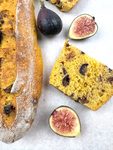
Pumpkin fig baguettes with a moist, golden crumb and nearly a quarter of the flour weight in dried figs. Start them the night before with a yeast poolish or a sourdough levain; the final dough is the same either way. Makes two 512g baguettes for 15-inch baskets.
Ingredients
Overnight build, yeast version (poolish)
50g whole grain spelt flour (a scant 1/2 cup)
50g water (3 Tbsp + 1 tsp)
a pinch of instant yeast
Overnight build, sourdough version (levain)
110g bread flour (3/4 cup + 2 Tbsp)
110g water (a scant 1/2 cup)
30g active 100% hydration starter (2 Tbsp)
Final dough, yeast version
all of the poolish (100g)
450g bread flour, 12 to 12.5% protein (3 1/2 cups)
235g water (1 cup), 25g held back
100g unsweetened pumpkin purée (1/3 cup + 1 Tbsp)
10g olive oil (2 1/4 tsp)
10g fine sea salt (1 3/4 tsp)
1/8 tsp instant yeast
120g dried figs, chopped (a generous 3/4 cup)
Final dough, sourdough version
all of the levain (250g)
325g bread flour, 12 to 12.5% protein (2 1/2 cups)
50g whole grain spelt flour (a scant 1/2 cup)
160g water (2/3 cup), 25g held back
100g unsweetened pumpkin purée (1/3 cup + 1 Tbsp)
10g olive oil (2 1/4 tsp)
10g fine sea salt (1 3/4 tsp)
1/8 tsp instant yeast
120g dried figs, chopped (a generous 3/4 cup)
Instructions
Make the overnight build. Mix the poolish or the levain the night before and leave it 12 to 14 hours at room temperature, until bubbly, domed, and just starting to flatten in the center.
Prepare the figs. Snip the figs into pieces around 1cm, cutting away any hard stem ends. Soak only if they are firm and leathery (see Notes). Autolyse. Combine the build, the water less the 25g reserve, the pumpkin purée, and the flour. Mix until no dry flour remains. Cover and rest 30 minutes.
Add the salt, yeast, and oil. Sprinkle them over the dough and work them in by squeezing and folding until fully incorporated. Assess the dough here. If it feels stiff, work in the reserve water. If it has slackened on its own, leave it out.
Add the figs during the first fold. Stretch the dough flat, scatter half the figs, fold, then repeat with the rest. They keep distributing through the later folds.
Bulk ferment. Give the dough three sets of stretch and folds at 30-minute intervals across the first hour and a half, then leave it alone. It is ready when it is smooth, puffy and well developed. The yeast version takes 2½ to 3 hours at room temperature. The sourdough version takes 3 to 4 hours at 76 to 78°F, and longer in a cool kitchen. The sugar in the figs moves both along, so start checking at the early end of the range.
Divide and preshape. Divide into two pieces of about 512g each. Preshape into rough logs and rest, covered, 20 minutes.
Shape. Pat each piece into a rectangle, letter-fold, seal the seam, and roll into a long taper to fill the basket end to end. If it springs back and refuses to lengthen, rest it for five or ten minutes under a cloth rather than forcing it. Tuck in what surface figs you reasonably can. At this much fruit, you will not get all of them, and that is what the bake temperature is for. Set seam side up in a well-floured 15-inch basket.
Final proof. Same day, 45 minutes to an hour at room temperature, until the dough springs back slowly when pressed. Or cover well, refrigerate overnight, and bake straight from the fridge.
Bake. Place one baking stone or steel on the middle rack with a steam pan below it, and preheat both at 450°F for 45 minutes. Keep the oven at 450°F from start to finish.
Turn the loaves out of the basket, score one long slash, and load them right away. Pour one cup of hot water into the steam pan and close the door. Steam only once.
Leave the door shut unless your oven has a hot side; if it does, turn the loaves end to end once the crust has set, about two-thirds of the way through.
If the loaves proofed overnight in the fridge, preheat fully before you take them out, then turn out, score, and load one loaf at a time. Do not let them warm on the counter, because the cold surface helps them hold their shape.
Bake two baguettes 20 to 23 minutes, to an internal temperature of 205 to 210°F. Treat the time as a range; color and internal temperature are more reliable than the clock. If the surface figs darken before the middle is done, lay a loose sheet of foil over the loaf and keep baking.
Cool completely. At least 30 minutes, and an hour is better. The pumpkin holds moisture, and the crumb reads gummy if you cut it warm.
Sizing
All at 450°F throughout. If the shaped loaves were refrigerated, load them directly from cold.
|
Making |
Pieces |
Weight each |
Total bake |
|
One baguette, half the recipe |
1 |
about 512g |
18 to 21 min |
|
Two baguettes, the full recipe |
2 |
about 512g |
20 to 23 min |
|
Bâtards, the full recipe |
2 |
about 512g |
26 to 30 min |
To make one loaf, halve everything. Three measures do not halve tidily: the pinch of yeast in the poolish stays a pinch, the ⅛ teaspoon of instant yeast in the final dough becomes a scant ¹⁄₁₆, and 30g of starter becomes 15g.
To scale, pick your total flour weight, then use water at 57%, pumpkin at 20%, olive oil at 2%, salt at 2%, and figs at 24%. That lands at 75% effective hydration at any size. Roughly 250g of flour makes one 512g loaf.
Notes
Hold back 25g of the water. Pumpkin purée varies more than any other ingredient here, and the reserve is what makes the recipe work with whatever you have.
About the pumpkin. Canned purée, not pie filling, is consistent and runs about 90% water. Home-roasted pumpkin is usually wetter. If you roasted your own, cook it down until it holds its shape on a spoon, drain it in a sieve for half an hour, or simply leave the reserve water out.
Where the spelt goes differs on purpose. In the yeast version it lives in the poolish, where twelve hours of gentle fermentation makes the most of it. In the sourdough version it goes into the final dough, because spelt ferments fast and a levain has enough acidity to weaken it overnight. Both versions carry the same 50g.
Why the levain is bigger. It does all the leavening on its own, so it holds 25% of the flour against 10% for the poolish. That keeps the two versions on roughly the same schedule.
Figs. Black Mission, Calimyrna, and Brown Turkey all work. Calimyrna are milder and sweeter; Mission are jammier with the most color contrast in the crumb, and Brown Turkey are thinner-skinned and seedier. If you dry your own and stop a little short of leathery, those are the ones to use: they go in unsoaked, hold their shape in the crumb better than a soaked fig, and the extra water buys a little time against scorching at the surface.
Should you soak the figs? Squeeze one. Bought dried figs that are firm and leathery will pull water from the dough and stay chewy, so cover them with warm water for 10 minutes, drain well, and pat dry. Figs that give easily under your thumb, including most home-dried figs, go in as they are. Either way, keep the soaking water out of the dough. It is sugary, it darkens the crumb, and it speeds the ferment.
The crumb may look grey around the fruit. That is normal, and more pronounced if the figs were chopped fine.
- Prep Time: 30 minutes
- Fermentation: 18 hours
- Cook Time: 23 minutes
- Category: Bread
- Method: Poolish
- Cuisine: French