
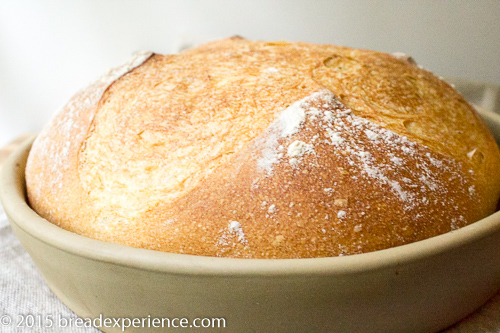
This Weeknight Semolina Bread is one of my favorites because it can be made completely on a weeknight after work.
I enjoy loaves made using a long, slow fermentation as much as the next gal, but sometimes, you just want a simple, no-fuss loaf that can be made in one evening from start to finish. This loaf fits the bill.
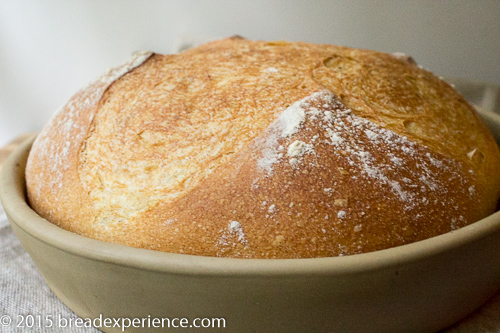
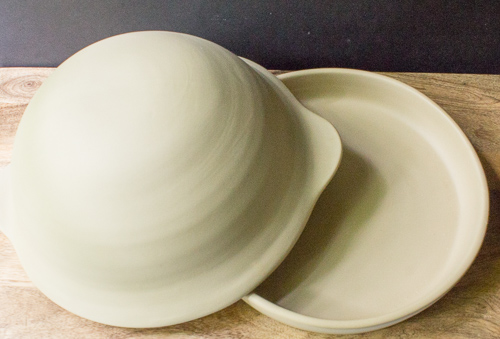
Disclosure: A few weeks ago, I received a charming ceramic bread cloche from Emerson Creek Pottery and I’ve been having lots of fun baking with it. This bread baker is made of unglazed, lead-free clay and handcrafted in the USA.
I’ve tested it on several different types of loaves made with various kinds of flour. I particularly enjoyed making Weeknight Semolina Bread in this artisan bread cloche.
Baking bread in a cloche
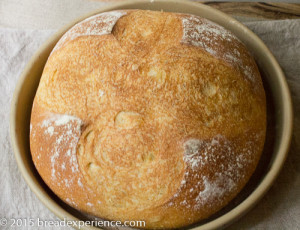
I enjoy baking in stoneware cloches because they transform your conventional oven into a brick oven. When you bake in a cloche, there is no need to spritz the loaves or the oven walls with water to create steam. The self-contained, domed unit provides the perfect environment for baking crusty loaves. You don’t even have to preheat the baker to get good results. The semolina loaf in the top photo was baked in an unheated cloche. The loaf opened up beautifully where it had been scored and had tremendous oven spring (rise) in the oven.
One of the things I particularly like about the Emerson Creek Pottery cloche, besides the fact that it’s handcrafted in the USA, is that it has handles on the sides of the domed lid. The handles allow you to easily grasp the lid, which is especially helpful when it’s time to remove it from the hot oven. I’ve lifted many a hot lid (precariously) to allow the crust to brown on the top of the loaf so I noticed the handles right away.
I also liked the fact that bread does not seem to stick as much to the unglazed unit. Just sprinkle the bottom with cornmeal before placing the loaf in it and you’re good to go. Or, if you prefer, you can use parchment paper. I was even able to shift the proofed loaf in the bottom of the baker after transferring it from a banneton (proofing) basket without it sticking to the sides. Since the loaf doesn’t always land directly in the middle when you flip it out of the basket, the fact that you can shift it around a bit without deflating the dough is a nice plus as well.
Here are some of the loaves I’ve made so far using this unglazed cloche. The mixed grain, buckwheat, and Einkorn loaves were proofed in lined banneton baskets and baked in the preheated unit. The semolina loaf was proofed and baked in the unheated cloche in a preheated oven.
As you’ll note from the photos below, I got varying levels of oven spring for each loaf baked in the cloche; however, I attribute that mostly to the type of flour used. The semolina loaf includes about 40% all-purpose flour which provides more strength to the loaf.
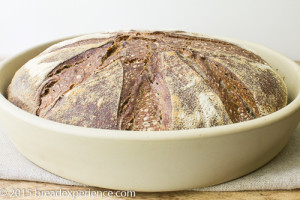
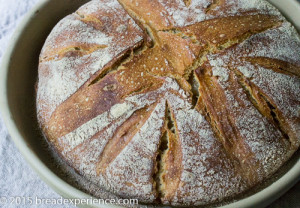
Making Weeknight Semolina Bread in a Cloche
I started making this bread after work around 5:15 p.m. and it was ready around 8:15 p.m. because I extended the proof time slightly.
If you want to serve the loaf for dinner, stick to a proofing time of 45 minutes each, for the bulk proof and final rise, and a proofing temperature of about 85 degrees F. My goal was to make this loaf after work. I succeeded and enjoyed it for a late dinner.
Print
Weeknight Semolina Bread in a Bread Cloche
Description
This Semolina Loaf is baked in a ceramic cloche and can be made in an evening from start to finish. The semolina provides a lovely creamy color and makes a great loaf for toasting and cheese sandwiches.
Ingredients
- 300 grams semolina flour *
- 200 grams all-purpose flour *
- 6 grams (1 1/8 tsp.) instant yeast
- 10 grams (1 1/2 tsp.) sea salt
- 15 grams (1 1 /2 T) olive oil
- 350 – 400 grams (1 1/2- 1 3/4 cups) water; divided
Instructions
- Measure the dry ingredients, except the salt, and place in a large bowl. Whisk together to combine.
- Pour in the water, reserving 50 grams (or a tablespoon), and mix using a wooden spoon or Danish dough whisk until it forms a sticky dough.
- Cover the bowl and let the dough rest (autolyse) for 15 minutes.
- Uncover the bowl and add the salt and the reserved 50 grams of water on top of the dough. Wet your fingers and mix until the salt is thoroughly incorporated into the dough. There shouldn’t be any undissolved salt crystals.
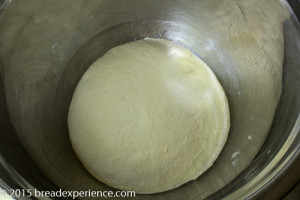
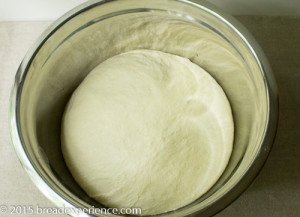
- Knead the dough until it forms a soft and pliable dough. Add a bit more flour if necessary. Recover the dough and let it bulk ferment for 45 minutes to an hour.
- Fold the dough after about 20 minutes then recover and let it continue bulk ferment until it is doubled in size.
- Punch down the dough and shape into a round loaf. Let the loaf rest on the counter for 10 – 15 minutes.
- Preheat the oven to 450 degrees F.
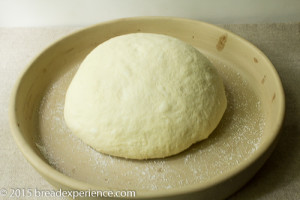
- Sprinkle the bottom of the cloche with cornmeal. Shape the loaf into a tighter ball and place in the cornmeal-dusted baker. Cover with a towel or the cloche lid and let the dough proof for 45 minutes to an hour, or until doubled in size.
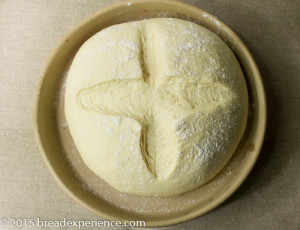
- Uncover the dough, and score the loaf using a serrated knife or lame. I scored it like a plus sign, but you can make 3 slashes or whatever you prefer.
- Transfer the bottom of the cloche to the preheated oven and place the lid on top. Bake the loaf for 15 minutes or so, then remove the lid and continue baking until the loaf is browned and sounds hollow when tapped on the bottom, about 30 – 35 minutes total.
- Remove the loaf to a wire rack to cool completely before slicing and serving.
Notes
* 500 grams (~ 3 3/4 cups) total flour is used in this loaf. You can include bread flour, all-purpose, semolina, or a mixture of semolina and all-purpose flours.
If you use semolina flour, you’ll need a little more water.
Adapted from: Classic French Bread in Wine, Food & Friends by Karen MacNeil
- Category: Artisan Loaf
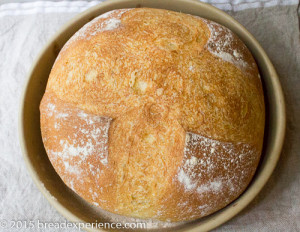
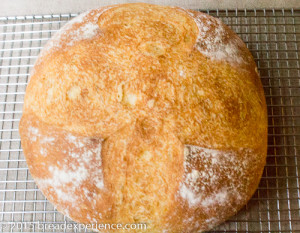
This is a very tasty loaf. The semolina flour provides a lovely creamy color. I enjoyed this bread toasted with butter, but it also makes an especially light and crispy grilled cheese sandwich.
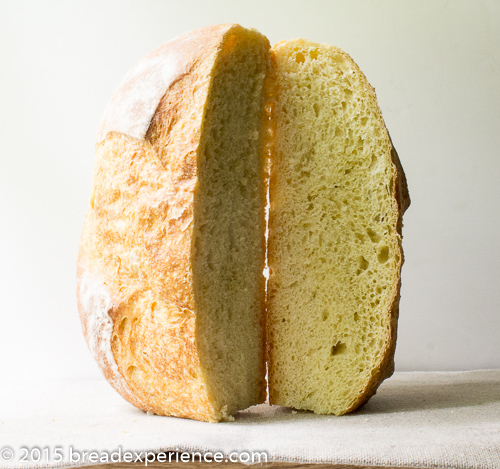
You can preheat the Emerson Creek Pottery Cloche before placing it in the oven or not. Since the cloche’s domed shape simulates a brick oven, it bakes loaves evenly throughout and helps artisan bakers achieve the crispy crust and the delicious crumb we strive for. I was very pleased that this cloche behaved the way you would expect it to and it had a few surprises as well – i.e. handles and unglazed surface.
Thank you to Emerson Creek Pottery for providing me with a ceramic baking cloche to review and giveaway.
Leave a Reply