
This basic savory bread, an easy artisan loaf that utilizes an overnight sponge, can be made into a basic loaf or used as the basis for other delicious breads. I decided to make the basic loaf and serve it with some homemade vegetable soup.
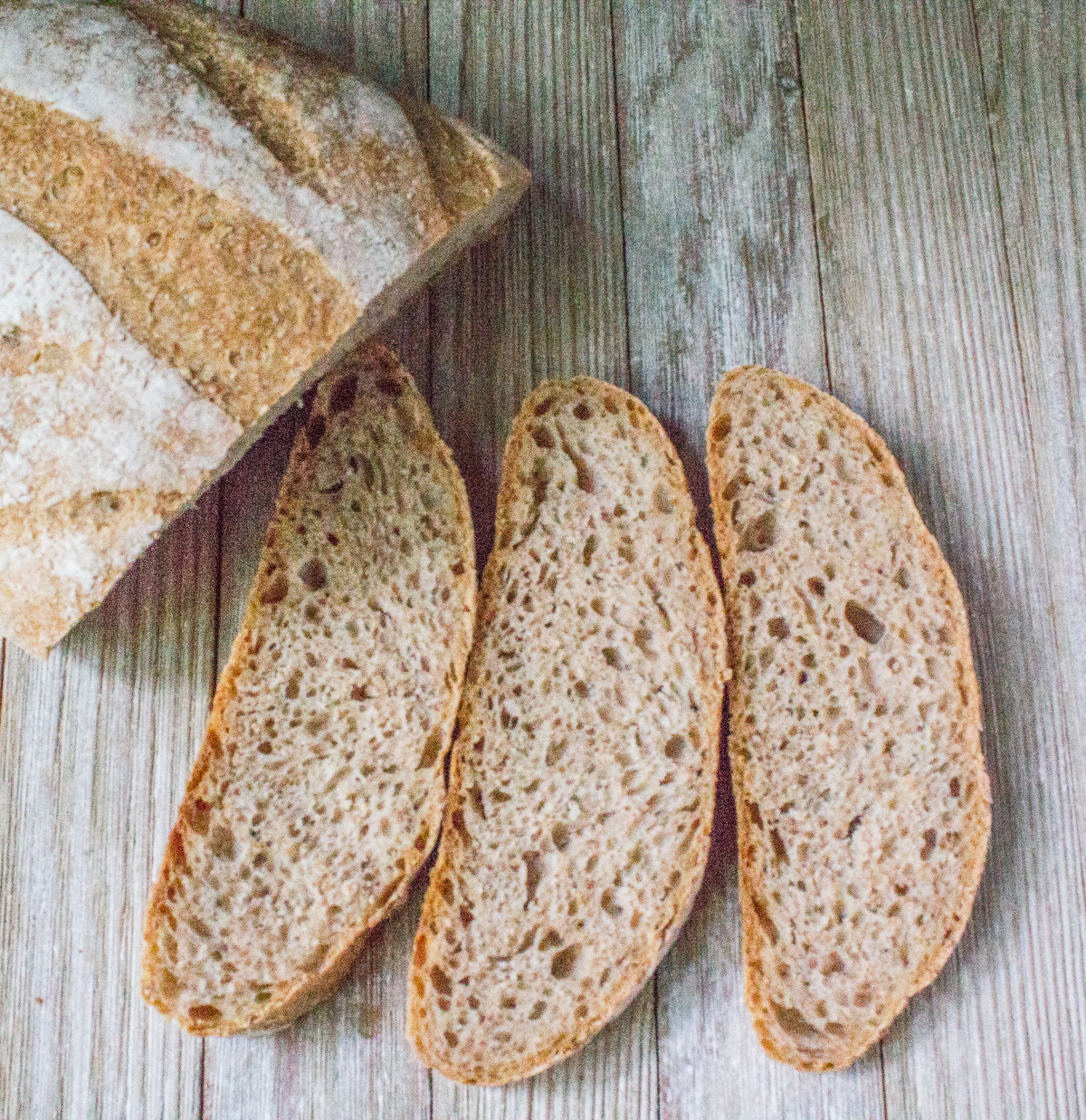
I had gotten a little bored with the bread I’d been making lately. So, I decided to break out of the bread box and try some different recipes.
I’ve had the book Bread Matters by Andrew Whitley for a while but hadn’t tried any of his bread recently. I decided to remedy that by making this artisan loaf.
THIS POST MAY CONTAIN AFFILIATE LINKS. FOR MORE INFORMATION, PLEASE VISIT THE PRIVACY POLICY PAGE.
Updated 06.24.22
I made this bread again and edited the ingredients slightly. I also updated the process.
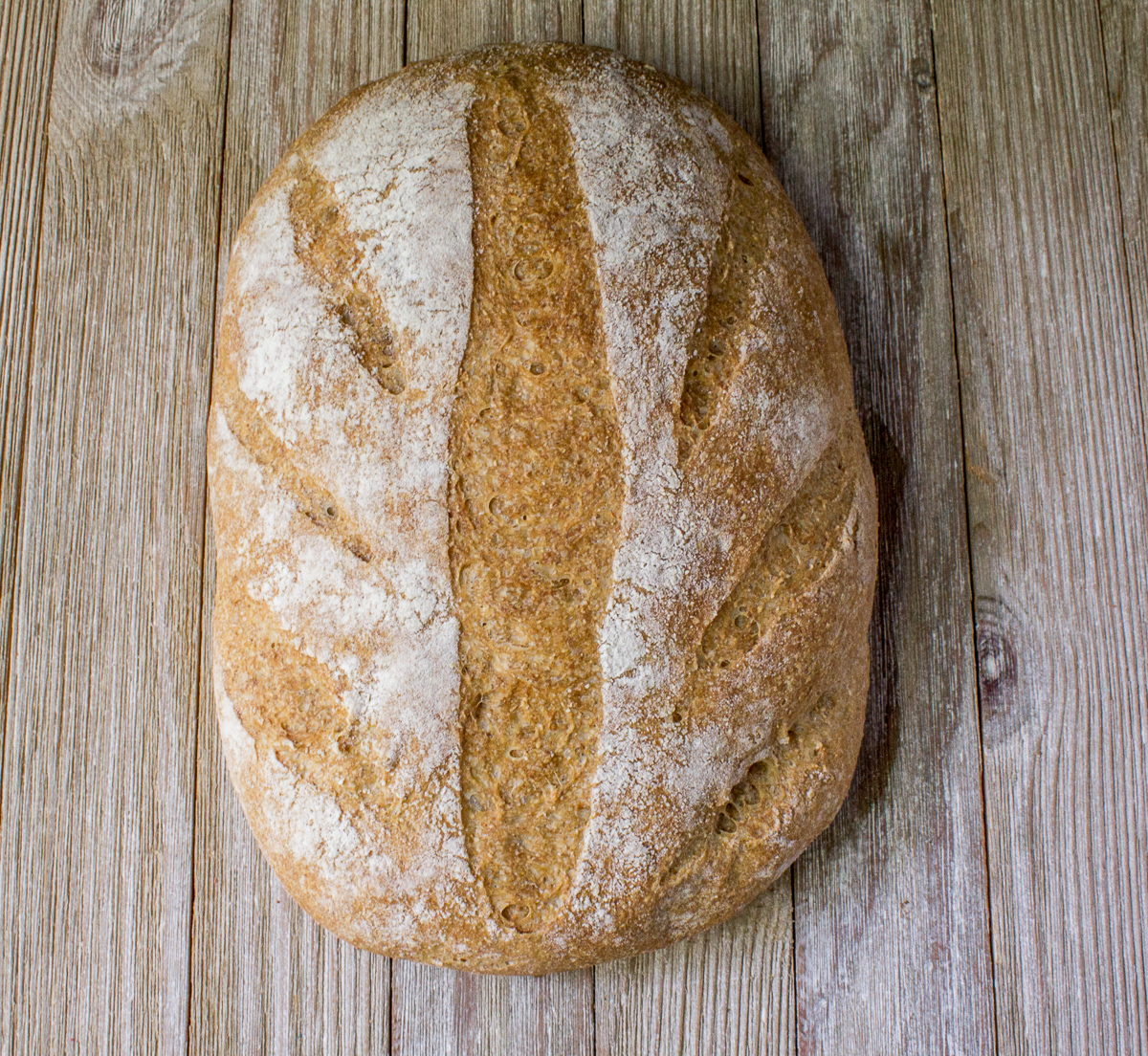
For the whole grain, I used red fife flour that was stone milled in a MockMill 100. The red fife gives the bread a lovely red hue.
I reduced the amount of dried yeast used in the sponge from a heaping 1/4 teaspoon to 1/8 teaspoon. I used instant yeast rather than active dry yeast so I didn’t need to activate it with water before using it in the sponge.
Depending on the temperature in your kitchen, this bread can overproof quickly.
Basic Savory Bread
Adapted from Bread Matters: The state of modern bread and a definitive guide to baking your own by Andrew Whitley
Makes: 1 loaf
This dough can be shaped into loaves or rolls.
Prepare the Sponge
- 1/8 tsp. instant dry yeast
- 150 grams / 2/3 cup water
- 75 grams / 1/2 cup plus 1 T. unbleached all-purpose flour
- 75 grams / 1/2 cup plus 1 T. stoneground whole-wheat flour
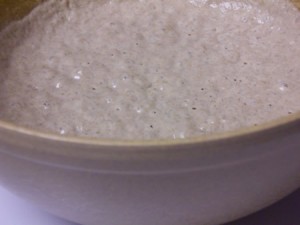
In a medium bowl, whisk together the flours and yeast. Pour in the water and mix thoroughly to form the sponge. Cover with plastic wrap and let the sponge ferment at room temperature for 16 – 48 hours. During the fermentation period, the sponge will rise up and then collapse. Depending on the temperature in your kitchen, it could take less time.
Make the Final Dough
- 225 grams / 1 cup (8 fl oz) Sponge (from above)
- 150 grams / 1 cup plus 2 1/2 tablespoon unbleached all-purpose flour
- 75 grams / 1/2 cup plus 1 tablespoon stoneground whole-wheat flour
- 4 grams / 3/4 teaspoon sea salt
- 15 grams / 1 tablespoon olive oil
- 105 grams / scant 1/2 cup water + more if needed
Use this formula to determine desired water temperature
If the sponge has been at room temperature in a cool place, you’ll need to use fairly warm water to bring the final dough to the desired temperature – 81 degrees F.
To figure out how hot the water should be, use the following formula. For the purposes of the calculation, treat the sponge as part of the flour. Add the temperatures together, then divide by two to arrive at an average.
2 x desired dough temperature minus actual flour temperature equals required water temperature.
If your desired dough temperature is 81 degrees F, the flour temperature in the Winter is probably around 43 degrees F and in the Summer it’s probably around 68 degrees F. Mine fell somewhere in between.
Winter: 2 x 81 = 162 – 43 = 119 degrees F
Summer: 2 x 81 = 162 – 68 = 94 degrees F
Using the formula, I figured out I needed to warm the water to about 110 degrees F.
Mix, Shape, Proof, Bake
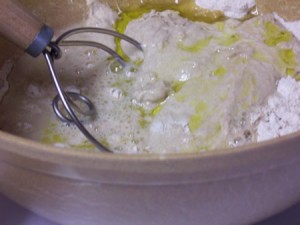
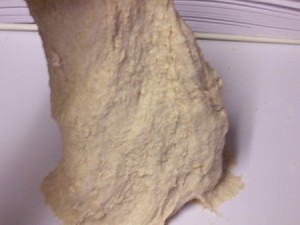
Mix all of the ingredients together and stretch and fold the dough in the bowl until there are no dry bits of flour. Add more water or all-purpose flour, if needed to create a workable dough.
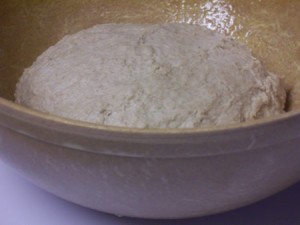
Cover and allow to bulk ferment for an hour or so. Perform two stretch and folds at 15 minutes intervals. Then allow the dough to rest for 30 minutes.
The dough can be shaped into loaves or rolls.
To bake it as a freeform loaf, remove the dough to a lightly floured surface. Preshape into a rough round. Let rest on the counter seam side up for 10 minutes.
Shape into a batard (oval) and place in a rice-floured lined or unlined oval banneton proofing basket.
Let the loaf proof in the basket for about an hour and a half. If it’s hot in your kitchen, reduce the proof to 45 minutes to one hour.
Meanwhile place a baking stone on the next to lowest rack of the oven and a steam pan or iron skillet on the lowest rack. When using a baking steel (which can get hotter than a baking stone), I place the steel on the middle rack to keep the bottom of the loaf from burning.
Preheat the oven to 400 degrees F. during the final 30-40 minutes of the final proof.
Carefully release the loaf from the banneton onto a parchment-lined baking sheet (sprinkled with cornmeal if desired) and score the loaf down the middle with a serrated knife or a bread lame.
Transfer the loaf (on the parchment paper) to the preheated baking stone. Place a cup of ice cubes in the steam pan or skillet.
Immediately close the oven door and let the loaf bake for about 25 minutes. Rotate the loaf partway through the baking cycle for even baking.
Remove the loaf to a wire rack to cool before serving.
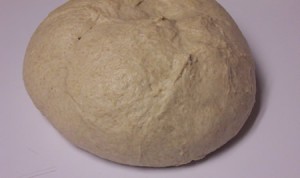
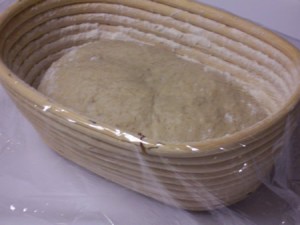
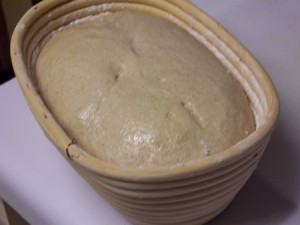
The loaf is a beautiful golden brown color due to the inclusion of whole wheat flour. It’s a very nice basic bread.
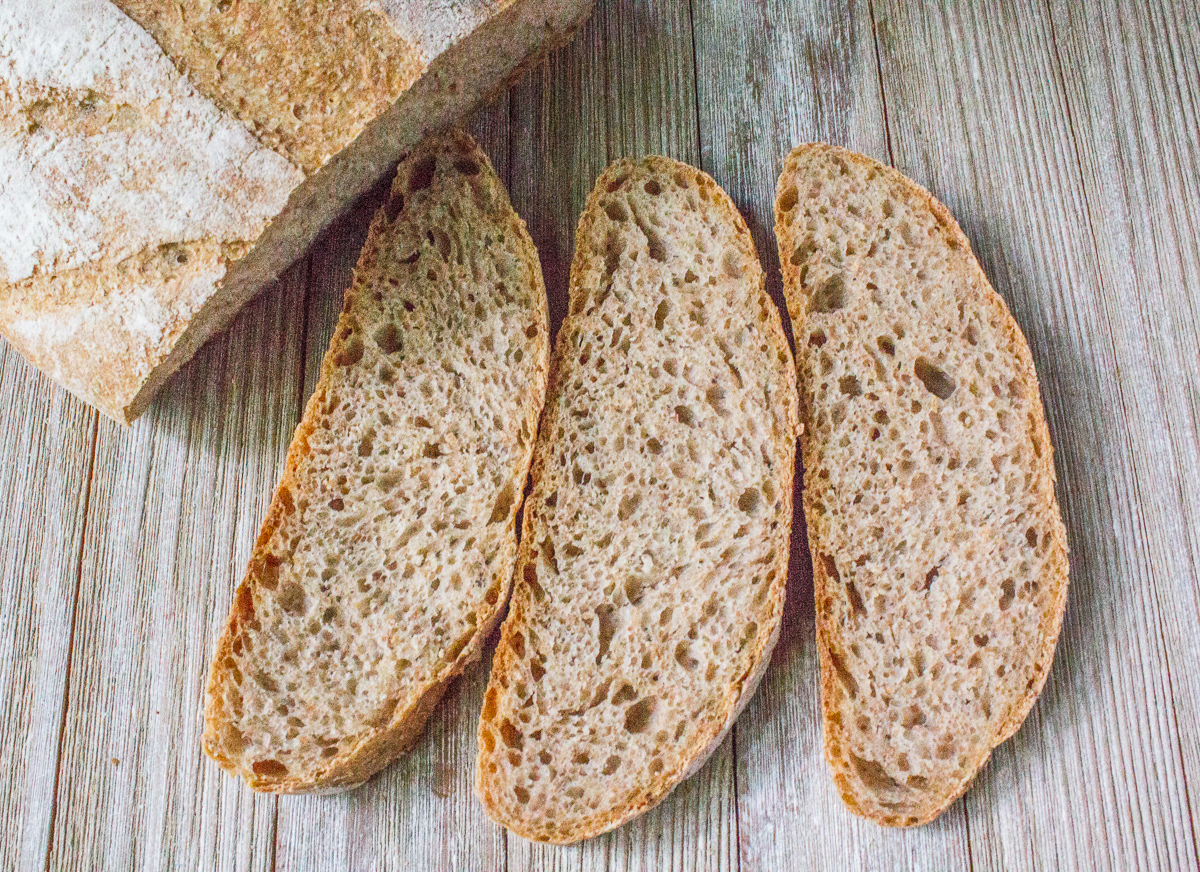
This bread tastes good warm with butter and pairs well with homemade vegetable soup.
It also tastes better after a day or so. It keeps well due to the sponge.
Happy Baking!
Cathy
Leave a Reply