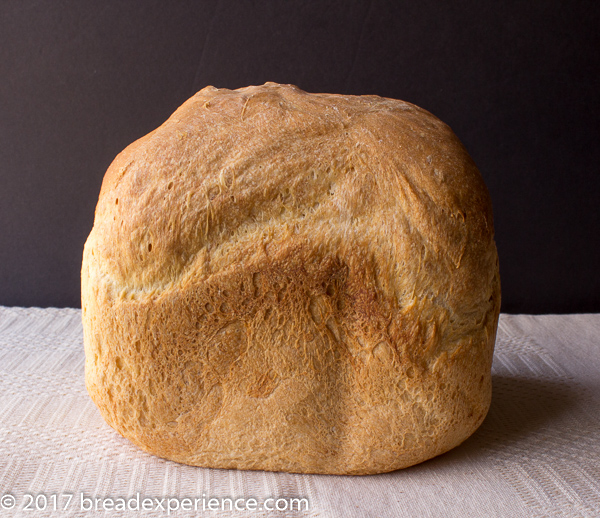
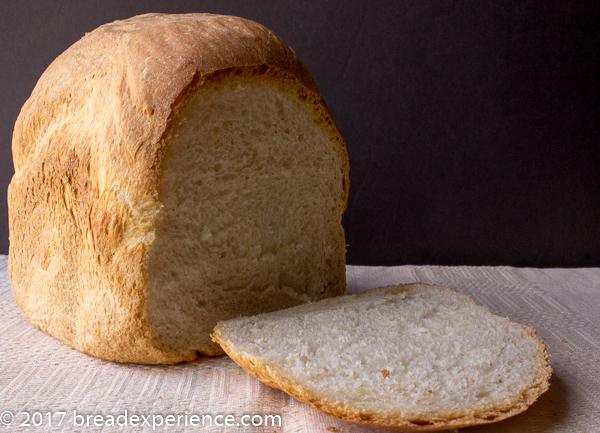
Sourdough Bread Machine Bread Sliced

Sourdough Bread Machine Bread Using an Active Sourdough Starter

Updated March 2026 with improved formatting and revised recipe notes.

This post covers how to make sourdough bread machine bread using an active sourdough starter along with flour, water, salt, and a little yeast. If you are looking for an easy sourdough sandwich bread to make in the bread machine, this method is a good place to start.
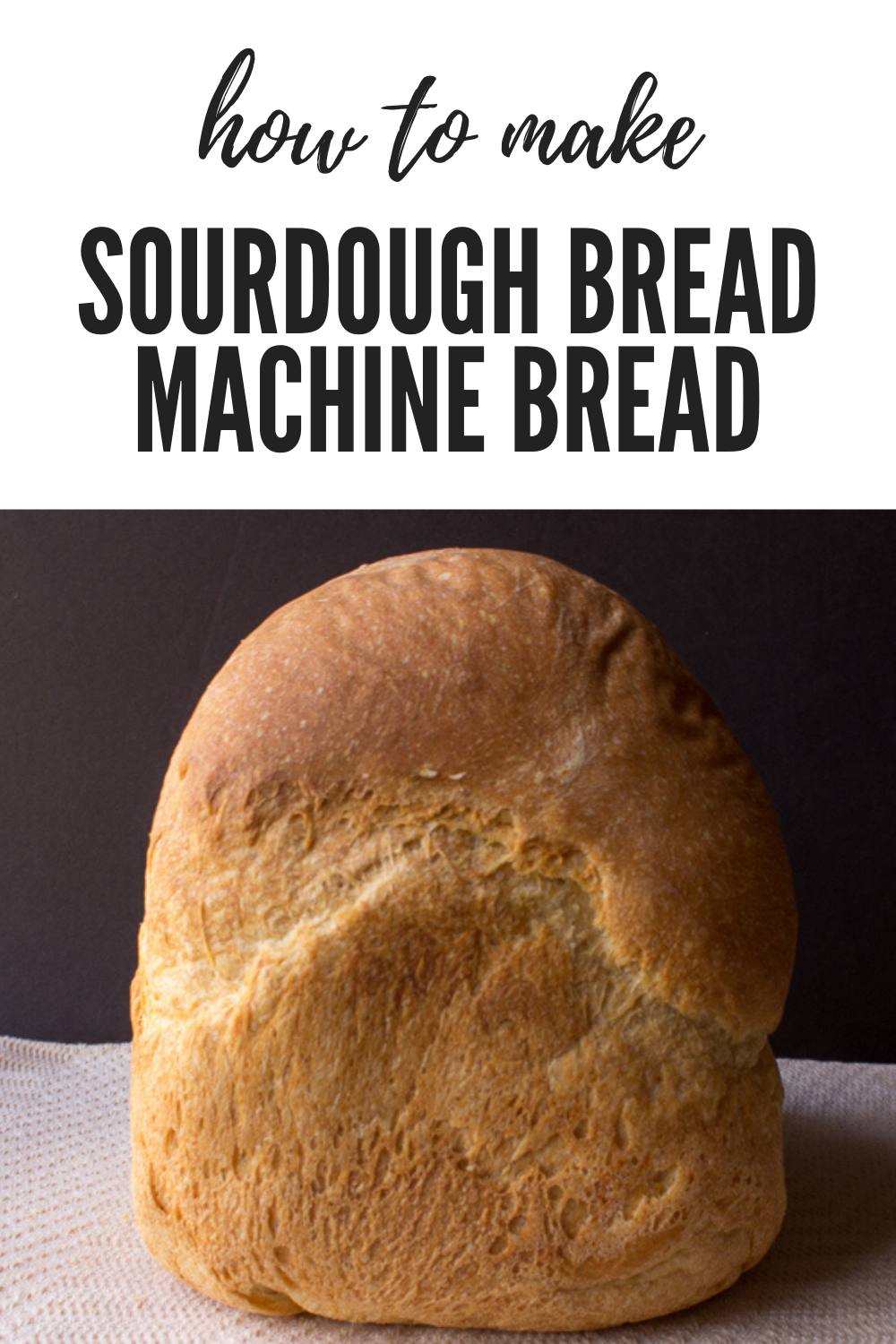
Tall golden-brown sourdough loaf shaped like a bread machine bake, on a cream cloth against a dark background, with text overlay "How to Make Sourdough Bread Machine Bread."

One thing worth knowing before you begin: this bread actually tastes more sour the next day. If you can wait, let it rest in a breathable bread bag on the counter overnight. The flavor develops considerably, and it is worth the patience.

The starter I used for this recipe came from a Boudin Bakery method. Getting it right took some trial and error. My first batch turned pink after a couple of weeks, which meant starting over, but the second attempt worked beautifully.

The starter is the foundation of this bread, so it is worth taking the time to develop it properly. Here is the method I used, adapted from a Boudin Bakery sourdough starter method. It takes a few days, but most of that time is hands-off.
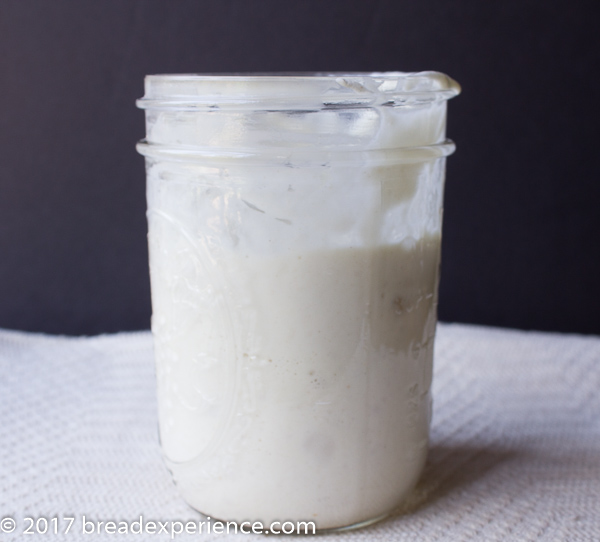
Mason jar of fed white sourdough starter on a cream cloth against a dark background.

Sourdough Starter for Bread Machine

Adapted from a Boudin Bakery sourdough starter method.

Ingredients:

  • 1/4 to 1/3 cup (31g to 42g) white unbleached all-purpose flour
  • 1 to 2 tablespoons (15g to 30g) water

Instructions:

Day 1. Make a small well in the flour and add the water. Slowly mix, and bring more flour into the center until the mixture transforms from a paste into a small piece of dough. Knead with your fingers for 5 to 8 minutes until springy. Place in a small bowl, cover with a damp cloth, and set aside in a warm spot for 2 to 3 days.

After 2 to 3 days. The dough will look moist, wrinkled, and crusty. Pull off a piece of the crust, and you should find tiny bubbles and a sweet aroma underneath. Discard any hardened crust. Refresh the remaining piece by mixing it with twice the original amount of flour and enough water to make a firm dough. Set aside as before.

After 1 to 2 more days. The starter will have a fresh, active look. Remove any dried dough and mix with about 1 cup of flour. Cover with a damp cloth and leave in a warm place for another 12 to 18 hours. When ready, the starter will appear fully risen, and a small indentation made with a finger will not spring back.

Storing the starter. Transfer to a large glass jar, cover, and refrigerate. A good starter will serve you for years.

Using refrigerated starter. Up to 12 hours before baking, stir the starter and discard 1 cup. Feed the remaining starter with 1/2 cup of water and 1 cup of flour. Let it sit for 4 to 12 hours before using. Use however much the recipe calls for, then feed the remainder with 1/2 cup water and 1 cup flour. Let it sit at room temperature for 2 to 4 hours until bubbly, then cover and refrigerate.

Weekly maintenance. If you are not baking for over a week, feed the starter once a week. Discard or use 1 cup, then mix in 1/2 cup water and 1 cup flour. You can return it to the refrigerator without waiting for it to bubble, though letting it sit on the counter for a couple of hours first improves the flavor for the next bake.

For more tips on maintaining a sourdough starter, visit my Creating a Sourdough Starter page.

Once your starter is active and bubbly, it is ready to be used in the bread machine.
Sliced sourdough bread machine loaf showing a soft white interior, with one slice laid in front, on a cream cloth against a dark background.

I used a basic sourdough bread recipe courtesy of Fleischmann Yeast and the “wild yeast” starter I created using the method above.

This bread machine recipe produces a mild, chewy sourdough that works well as an everyday sandwich bread. The flavor deepens overnight, so if you can resist cutting into it right away, it is worth the wait.
Print
clock clock iconcutlery cutlery iconflag flag iconfolder folder iconinstagram instagram iconpinterest pinterest iconfacebook facebook iconprint print iconsquares squares iconheart heart iconheart solid heart solid icon
Baked loaf of Sourdough Bread Machine Bread resting on a white cloth

Basic Sourdough Bread Machine Bread


5 Stars 4 Stars 3 Stars 2 Stars 1 Star

No reviews

  • Author: Bread Experience
  • Yield: 1 Loaf 1x

Description

A mild, chewy sourdough made in the bread machine using an active wild yeast starter. Simple enough for everyday baking and works beautifully as a sandwich bread.


Ingredients

Units Scale
  • 3/4 cup (188g) sourdough starter, 100% hydration, at room temperature
  • 1/4 cup (59g) water
  • 1 tablespoon (14g) butter
  • 3/4 teaspoon (4.5g) salt
  • 2 cups (254g) bread flour
  • 2 teaspoons (8.4g) sugar
  • 1 1/2 teaspoons bread machine yeast

Instructions

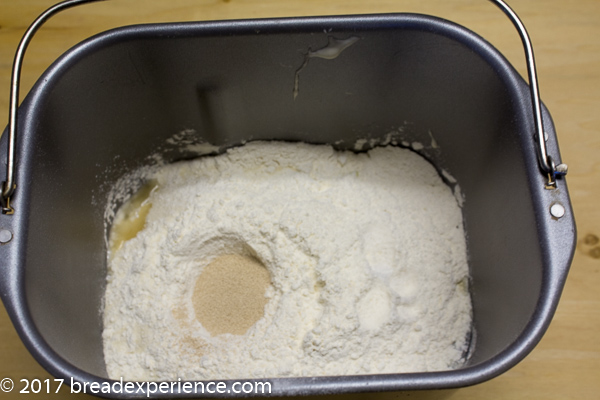
  1. Add ingredients to the bread machine pan in the order suggested by your manufacturer.
  2. Select the basic or white bread cycle with a medium or normal color setting.
  3. After mixing for a few minutes, the dough should form a smooth ball around the kneading blade. If it looks too stiff, add liquid one teaspoon at a time. If it’s too soft, add flour one teaspoon at a time. Do not add more than 3 to 4 teaspoons total.
  4. At the end of the bake cycle, remove the bread from the pan and cool completely on a wire rack before slicing.
  5. Store in a breathable bread bag on the counter. The flavor develops and becomes more sour overnight.

Notes

For a 1.5-pound loaf, use 1 1/4 cups (313g) starter, 1/3 cup (79g) water, 1 tablespoon (14g) butter, 1 teaspoon (6g) salt, 3 cups (381g) bread flour, 1 tablespoon (12.6g) sugar, and 2 teaspoons (6.3g) bread machine or instant yeast.

If you use a stiffer starter rather than a 100% hydration starter, you may need to increase the water. When testing the 1-pound loaf with a stiffer starter, I needed 1/2 cup of water instead of 1/4 cup. Watch the dough during the first few minutes and adjust accordingly.

This recipe makes a mild sourdough, which I prefer for sandwich bread. For a more sour flavor, combine the water, starter, and half the flour in a medium bowl. Cover and let stand for 24 hours until very sour and bubbly. Then combine with the remaining ingredients in the bread pan and proceed as directed.

The timed-bake feature can be used with this recipe.

For a grape-based wild yeast starter variation, see my Natural Grape Sourdough Starter post.


Both of these recipes take a little patience, but that is part of what makes sourdough so satisfying. Once you have an active starter going, the bread machine performs most of the work from there.

I hope you enjoy the process as much as the bread.

Happy Baking!
Cathy

Comments

22 responses to “Sourdough Bread Machine Bread Using an Active Sourdough Starter”

  1. Thannks for the new view–there are a lot of sourdough starter recipes and sourdough breads online that simply don’t work. I hope this one does. I will try it out and post tomorrow night.

  2. Cathy (breadexperience)

    Hi Anonymous! Thanks for visiting. It’s been awhile since I’ve made this bread so do let me know if you like it. I liked the fact that it could be made in the bread machine.

  3. 4159b948-cdd6-11e0-b6b0-000bcdcb5194

    First time working with a sourdough starter and I want to eventually use this to make several loaves at a time. If I want to “grow” this starter, can I keep feeding it w/o discarding for a few weeks?

  4. If you use the over night method can you skip the two tsp of yeast?

    1. Hi Jes, This bread needs a longer fermentation in order to develop sufficient volume. If your machine has a cycle with a long second rise (perhaps a French bread cycle), then you could probably reduce the yeast by about 1/2 tsp, but I wouldn’t omit the add’l yeast altogether.

  5. There is no yeast in starter, is that in error?

    1. Hi Jessey, the starter will be the leavening or “wild yeast” in this bread. No additional dried yeast is necessary in the starter; however, there is additional yeast in the final dough.

  6. I love all the sourdough possibilities you have provided for us. I’ve used your classic recipe with my own variations and it turned out great. I want to do a bread machine version but don’t want to use yeast or sugar and I’d like to use a sprouted rye flour. Any suggestions? Thanks 🙂

    1. Hi Laura,

      I haven’t tried using only sprouted rye in a bread machine recipe. Are you going to incorporate bread flour as well? If not, it could be fairly dense. IF you don’t mind using molasses, you might try this recipe and just use your starter instead of the yeast http://www.breadexperience.com/rye-bread-recipe/ or this one that uses honey http://www.breadexperience.com/beer-rye-bread-in-bread-machine/.

      Happy Baking!
      Cathy

  7. I have made this 3 times in the last month. We like it. I had to add an additional 3 teaspoons of water during the kneading stage

    1. Hi Gilda, thanks for sharing. It’s always a good idea to watch the dough even in a bread machine. I’ve had to add extra water sometimes as well depending on the temperature in my kitchen.

  8. What’s the percentage of starter in to 100 % of bread flour? Thanks
    I m confused about the right amount to use in a loaf of bread..

    1. Hello Clancy, are you referring to the amount of sourdough you need to use to make this sourdough bread machine loaf? If so, it’s 3/4 cup for a 1-pound loaf and 1 1/4 cups for a 1 1/2-pound loaf. If you are referring to making sourdough bread in general, typically you’ll use about 20 percent, but if you allow the dough to ferment overnight or longer, you can get away with using less sourdough.

  9. Emma Petchey

    absolute failure! Turned out like a large scone. I followed the 24 hour sitting method and then added everything in order of bread machine. Not sure why it never rose any more. Perhaps too dry?

    1. Hi Emma,

      I’m sorry to hear your sourdough bread machine bread didn’t turn out right. Did you add the dried yeast as well to give it a boost?

      I had this happen to me when I made a different sourdough bread machine bread. The first time I made the bread, it turned out flat because my starter wasn’t active enough, and I didn’t add any extra yeast. The 2nd time I made the loaf, I added the extra yeast and it rose very nicely. Refer to this post https://www.breadexperience.com/making-sourdough-bread-using-natural/

  10. Judy Pitsinger

    I am diabetic. What to use instead of sugar. All so I am not to use salt. Is that a problem??????

    1. Hi Judy, you can use honey instead of sugar if it is allowed in your diet. I haven’t tried making this bread without salt, but I do know that omitting salt affects the browning of the bread as well as the flavor. It might also make the bread more crumbly.

  11. I used to make yeast bread a long time ago, slavishly following a recipe. But now during the pandemic, yeast is impossible to find (I had a very little in the fridge), so I decided to try homemade sourdough starter. I love sourdough bread. I just mixed water and flour to a thin batter consistency, and within days (with some feedings) it was bubbling and nice and sour. I ditched recipes (still making sure to use some salt and olive oil) and just went by dough consistency: if it’s slightly sticky.

    I have an old-fashioned stove with pilot light, so I use the pilot-warm oven for fermenting stuff.

    I took a little of my remaining yeast and started a culture (shake often) with sugar water, but it’s total guesswork how much of this suspension to use. I add about a tbsp suspension and a tsp sugar to sourdough to help it raise faster, but results are variable.

    Note to Judy (above): if you let the yeast or sourdough culture work long enough, it uses up most of the sugar, converting it to gas and alcohol. The sugar is microbe fuel. I could tell that my bread machine basic recipe didn’t let it raise long enough, because I could still taste the sugar in the bread.

    Bread machines also became impossible to find, but we found one in a thrift shop. No sourdough advice in the online pdf manual, so I was glad to read your material. It’s now too hot to run the oven, so I want to use the bread machine. Outdoors 🙂 . Thanks!

    Questions:
    I like to mix about 10% to 20% multigrain flour for flavor. How would this affect the sourdough culture for bread machines?
    Do you have any suggestions on how to use/measure the cultured yeast? Are there any precautions I should be aware of? Can I dry the cultured yeast to emulate store-bought?

    1. Hi Mike, thank you for your comments.

      I haven’t used cultured yeast in the manner you mentioned. However, you can dry a regular sourdough starter. I haven’t tried using it dried in a recipe although I think you can. I have stored it in the refrigerator dry for several months and restarted it later. This is a good way to reserve some starter in case for some reason the liquid (activated) form gets thrown out or goes bad.

      I’m not clear if you are saying you like to add multigrain flour to your starter or the final dough, but adding a bit of whole wheat flour to the sourdough starter will increase the activity. Adding multigrain flour to the final dough will make a heavier bread. You will probably want to increase the hydration.

    2. Just a note about buying a bread machine from thrift stores: nine and a half times out of ten the kneading paddle will be missing. Take down the name and model number of the machine and search to see if you can obtain that part before buying a used machine. Kneading paddles are not universal and are seldom interchangeable between machines.

  12. Really do need 1/2 cup water for 1.5 lb loaf.

    1. Thanks for the suggestion! As with any bread, the hydration can be adjusted as needed.

Leave a Reply

Your email address will not be published. Required fields are marked *

Recipe rating 5 Stars 4 Stars 3 Stars 2 Stars 1 Star