
For Day 15 of the Bread Baker’s Apprentice Challenge, we made Italian Bread.
This Italian Bread is made with a biga. A biga is the Italian version of a firm pre-ferment. This formula also incorporates diastatic malt powder to give the loaves a beautiful color. The bread is really good!
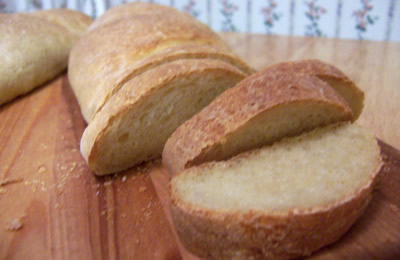
There are many different kinds of Italian breads.
Did you know that Italy was once made up of a number of independent states, and each developed its own favorite bread? As it turns out, the distinguishing characteristic of most Italian bread is not with the dough itself, but in the shaping, slashing and baking of the bread.
— Ingram, Christine and Shapter, Jennie. Bread: The breads of the world and how to bake them at home.
You might enjoy some of these other Italian Bread recipes.
Italian Bread
Makes: 2 Loaves
Slightly adapted from: The Bread Baker’s Apprentice by Peter Reinhart
Ingredients:
Biga:
- 2 1/2 cups unbleached bread flour
- 1/2 teaspoon instant yeast
- 3/4 cup plus 2 tablespoons to 1 cup water, at room temperature
Final Dough:
- 3/12 cups biga
- 2 1/2 cups unbleached bread flour
- 1 2/3 teaspoons salt
- 1 tablespoon sugar
- 1 teaspoon instant yeast
- 1 teaspoon diastatic barley malt powder (optional)
- 1 tablespoon olive oil, vegetable oil, or shortening
- 3/4 cup to 3/4 cup plus 2 tablespoons water
- Semolina or cornmeal for dusting
Prepare the Biga
Stir together the flour and yeast in a bowl or you can use your stand mixer if you prefer. I like to do it by hand whenever possible. Add the water and stir until everything comes together and makes a coarse ball. Adjust the flour or water as necessary to ensure the dough is neither too sticky nor too stiff. Cover the bowl with plastic wrap and let it ferment at room temperature for 2 to 4 hours, or until it nearly doubles in size.
Remove the dough and knead it lightly to degas. Return the dough to the bowl and recover with plastic.
Place the bowl in the refrigerator overnight or for up to 3 days. You can also freeze it at this point for up to 3 months. Just make sure you use an airtight plastic bag. I kept mine in the refrigerator for a couple of days until I was ready to bake it.
Make the Final Dough
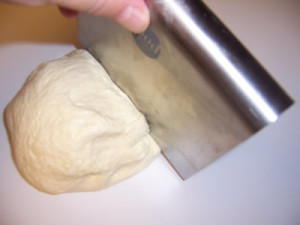
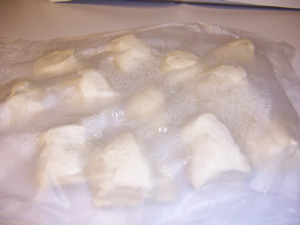
Remove the biga from the refrigerator 1 hour before making the dough. Cut it into about 10 small pieces with a pastry scraper. Cover the dough with plastic wrap and let it sit on the counter for an hour to take off the chill.
Stir together the flour, salt, sugar, yeast, and malt power in a bowl. Add the biga pieces, olive oil, and water and stir together until a ball forms. The dough should be slightly sticky and soft, but not batter like or too sticky. Adjust the flour or water as necessary.
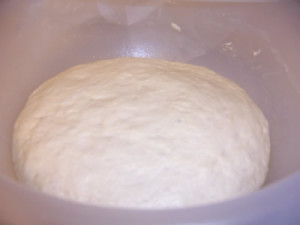
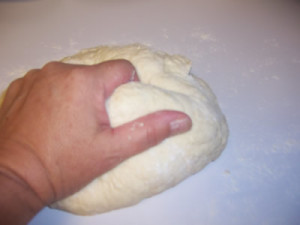
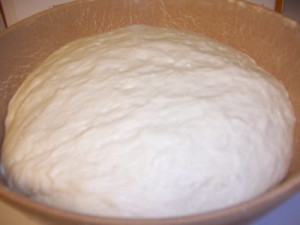
Remove the dough to a floured counter, and knead for about 10 minutes or until the dough is tacky, but not sticky, and supple. Transfer the dough to a lightly oiled bowl and roll the dough around to coat it. Cover the dough with plastic wrap and let the dough ferment at room temperature for 2 hours or until it doubles in size.
Shaping & Proofing the Loaves
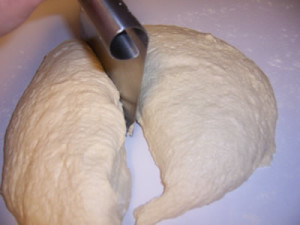
Remove the dough from the bowl and transfer it to a lightly floured counter. Cut the dough into 2 equal pieces (about 18 ounces each).
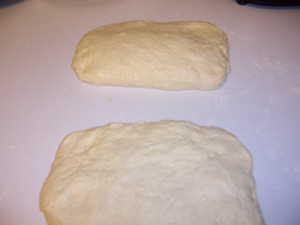
Form the pieces into batards making sure to degas them as little as possible. Start by gently patting the dough into a rough triangle.
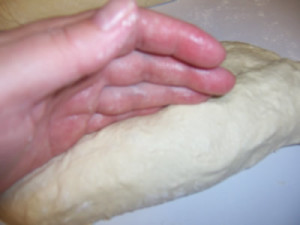
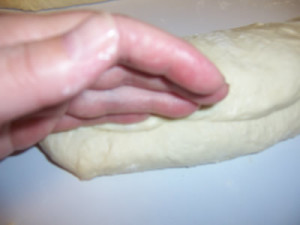
Being careful not to degas the dough, fold the bottom third of dough, letter style, up to the center and press to seal, creating surface tension on the outer edge.
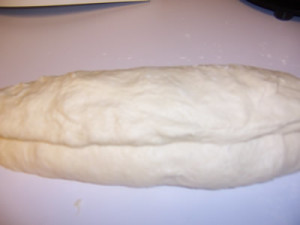
Fold the remaining dough over the top. Use the edge of your hand to seal the seam closed and to increase the surface tension all over.
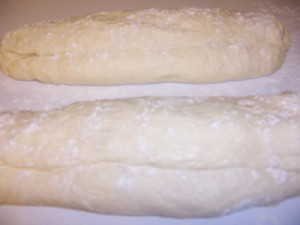
Lightly dust the loaves with flour. Cover the loaves with plastic wrap and let them rest for 5 minutes. After the batards have rested, extend the loaves to about 12 inches in length.
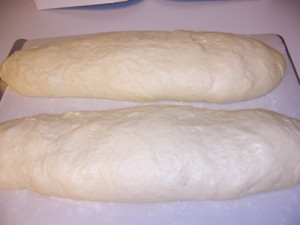
Line a sheet with baking parchment and dust with cornmeal. Place the loaves on the pan and lightly mist with spray oil. Cover loosely with plastic wrap. Proof at room temperature for about an hour, or until the loaves have grown to about 1 1/2 times their original size.
Prepare the oven for hearth baking
Preheat the oven to 500 degrees F. Score the loaves with 2 parallel, diagonal slashes or 1 long slash. I painted the loaves with water first so that the lame wouldn’t get stuck in the dough. It seems to help a little bit.
Dust a baker’s peel or the back of a sheet pan with cornmeal and very gently transfer the batards to the peel or pan. I used a baking pan without sides and parchment paper sprinkled with cornmeal. Transfer the batards to the baking stone. Pour a cup of hot water into the steam pan and close the oven door. After 30 seconds, spray the oven walls with water and close the door. Repeat 2 more times at 30 second intervals.
Then lower the oven setting to 450 degrees F. and bake for 10 minutes. Rotate the loaves for even baking and continue baking another 10 minutes, or until the loaves are a rich golden brown. It should take about 20 minutes for the loaves.
Remove the loaves from the oven and cool on a rack for at least an hour before slicing or serving.
Thanks for joining me for the Bread Baker’s Apprentice Challenge.
Click here to see all of the breads we made in the challenge.
Happy Baking!
Cathy
Leave a Reply to RodinkasJoy Cancel reply