
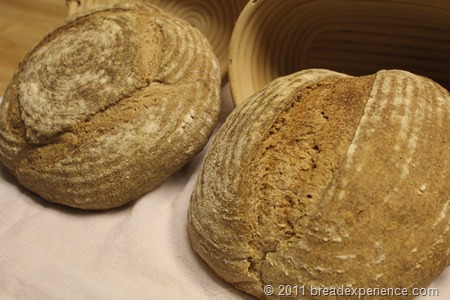
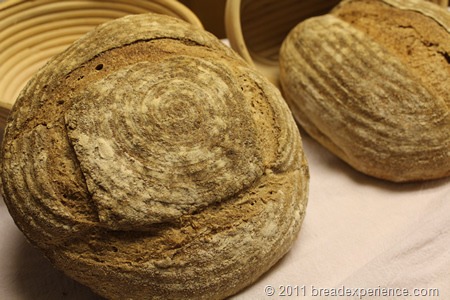
I’m starting to like Rye Bread. I particularly like the complex flavors in this Whole Wheat and Rye Bread. The sourdough is made with freshly-milled whole-rye flour, water, and a mature culture, and the final dough is made with a mixture of high-gluten flour and freshly-milled hard white winter wheat flour, in addition to the sourdough.
The whole wheat flour enhances the flavor of the bread and when it’s combined with the rye sourdough, provides good moisture retention as well as good keeping quality. In addition, the freshly-milled white winter wheat gives the loaves a golden color rather than the darker color that is achieved when using hard red winter or hard red spring wheat.
Whole Wheat and Rye Sourdough Bread
Makes: 2 large loaves
Adapted from Bread: A Baker’s Book of Techniques and Recipes by Jeffrey Hamelman
Sourdough:
- 2 1/8 cups Whole Rye Flour (I used freshly-milled whole rye flour)
- 7/8 cup water
- 1 tablespoon + 1 teaspoon mature sourdough culture
Final Dough:
- 3 5/8 cups High-gluten flour
- 1 3/4 cups White Whole-Wheat Flour (I used freshly milled flour)
- 1 3/4 cups Water
- 1 tablespoon Salt
- 1 teaspoon Yeast, instant dry
- Sourdough (all of the above minus 1 T + 1 teaspoon)
Directions:
Making the Sourdough: Mix the sourdough and let it ripen for 14 to 16 hours. I let mine ripen for about 15 hours.
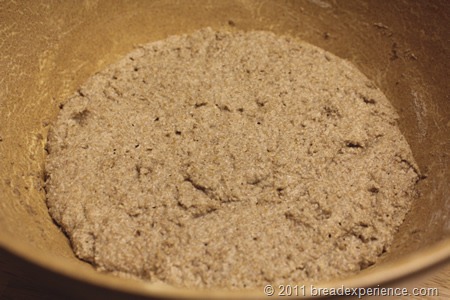
Mixing the Dough: Mix all of the ingredients in a spiral mixer for 3 minutes on first speed, and 3 minutes on second. Because this bread includes rye and whole wheat flour, you may need to mix the dough a little bit longer to develop the gluten.

Bulk Fermentation: Place the dough in a lightly oiled bowl, cover with plastic wrap, and let it bulk ferment for 1 hour.
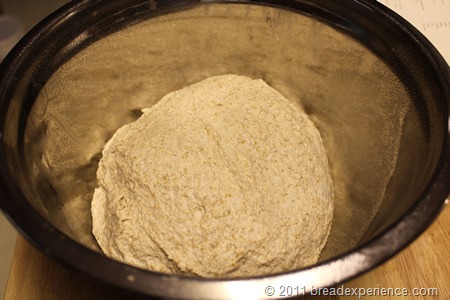
Shaping the Dough: Divide the dough into 1.5-pound pieces, shape round or oblong. I shaped the dough into rounds and let them rest on the counter for a few minutes.
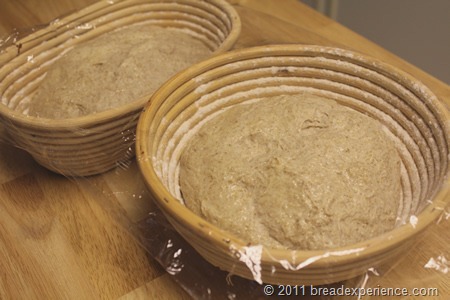
Final Fermentation: Place the dough in banneton baskets or other proofing baskets that have been heavily dusted with a mixture of rice flour and all-purpose flour and let the loaves rise for 50 to 60 minutes. I used an 8” round banneton basket and a 9” oval banneton basket and covered them with plastic wrap during the final fermentation.
Scoring the Loaves: Carefully remove the loaves from the baskets onto parchment paper sprinkled with cornmeal. I put the parchment paper on my baker’s peel to make it easier it to load it in the oven. You can also use the back of a baking sheet if you don’t have a peel.

Score the loaves using a serrated knife or lame. I used a lame.
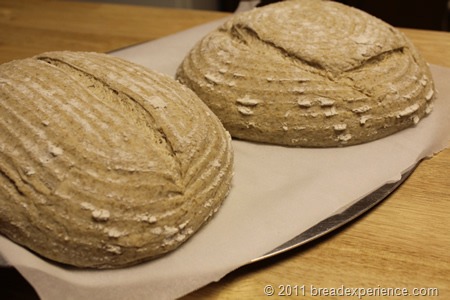
Baking the Loaves: About 30 minutes before baking time, preheat the oven to 450 degrees with a baking stone on the middle rack and a steam pan underneath. Carefully slide the loaves onto the baking stone and add hot water to the steam pan and close the door. Bake the loaves for 15 minutes, then lower the temperature to 425 degrees and bake the loaves for another 20 to 25 minutes.
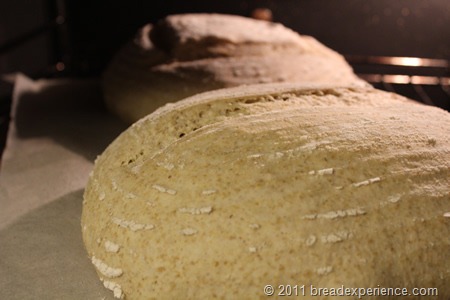
Cooling the Loaves: Remove the loaves from the oven and let them cool on a wire rack.
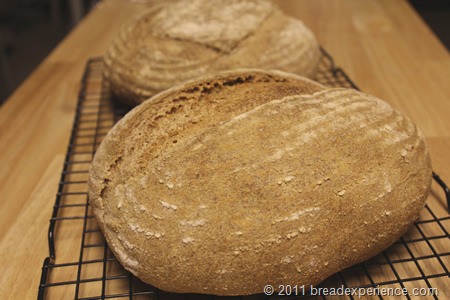
Enjoying the Loaves: After the loaves have cooled sufficiently, slice and enjoy.
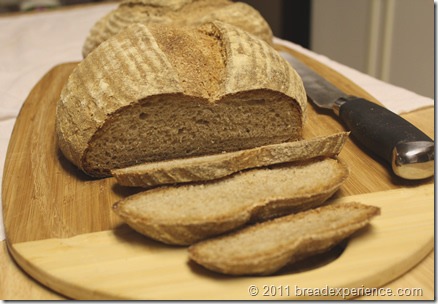
This bread has a tangy sourdough rye flavor and tastes good dipped in olive oil. We’ve had a welcome reprieve from the extreme heat this past week so I also enjoyed this bread with some delicious homemade vegetable soup.
Resources for Home Milling
This bread has been YeastSpotted. Please visit Wild Yeast to view all of the lovely breads in the roundup.

Mellow Bakers was started by Paul at Yumarama. We baked breads from Bread: A Baker’s Book of Techniques and Recipes by Jeffrey Hamelman.
Happy Baking!
Cathy
Leave a Reply