
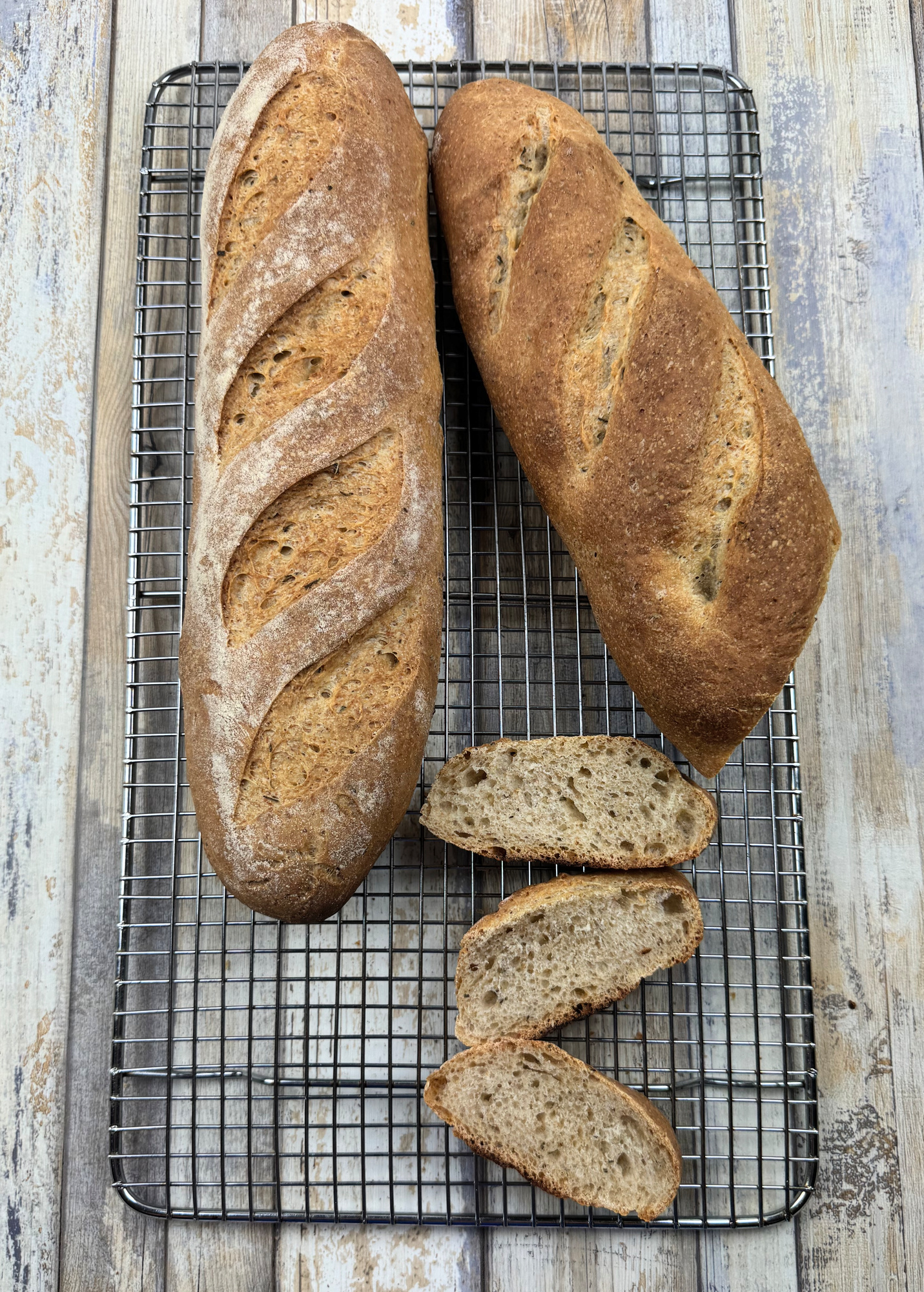
Olive oil is a seasonal ingredient, even if the bottle on your shelf doesn’t look like one. Olives are pressed in October and November, and the new-harvest oil that comes out of that is fresh, cloudy and peppery. If you ever buy a bottle of it, these olive oil and rosemary baguettes are the bread to spend it on.
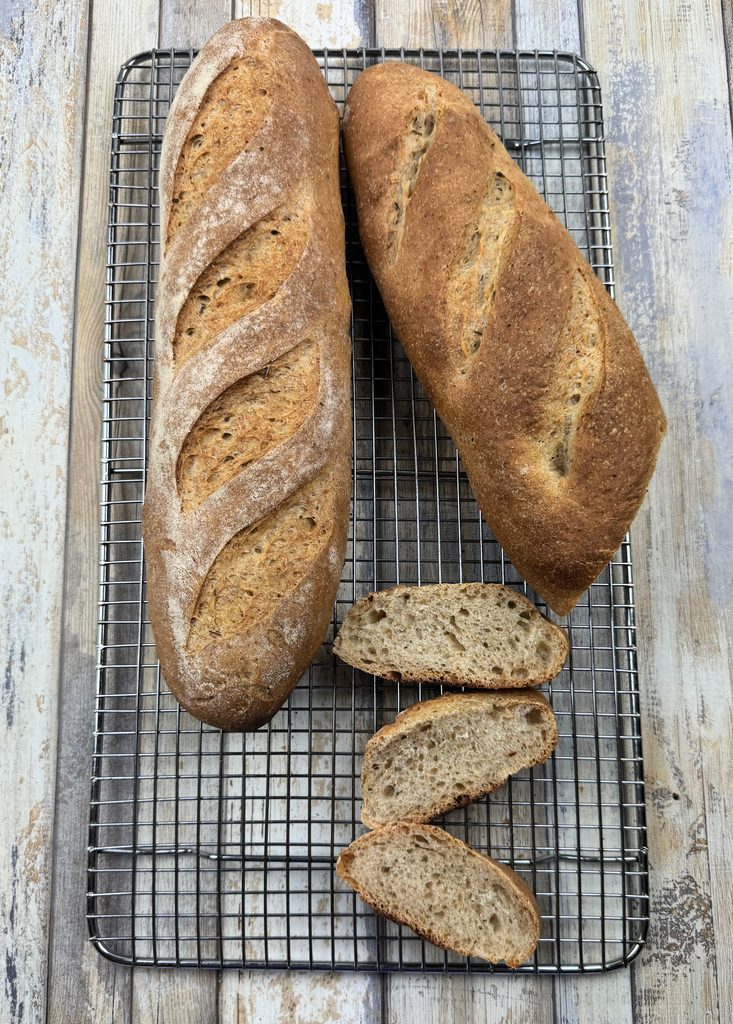
This recipe is adapted from the Bread Baking Babes challenge of April 2021.
For that challenge, the dough was shaped into a pull-apart wreath. To try your hand at shaping a pull-apart wreath, refer to this post: Rustic Mixed Grain Olive Oil Wreath.
In this Olive Oil and Rosemary Baguettes’ post, the same dough becomes two 15-inch baguettes.
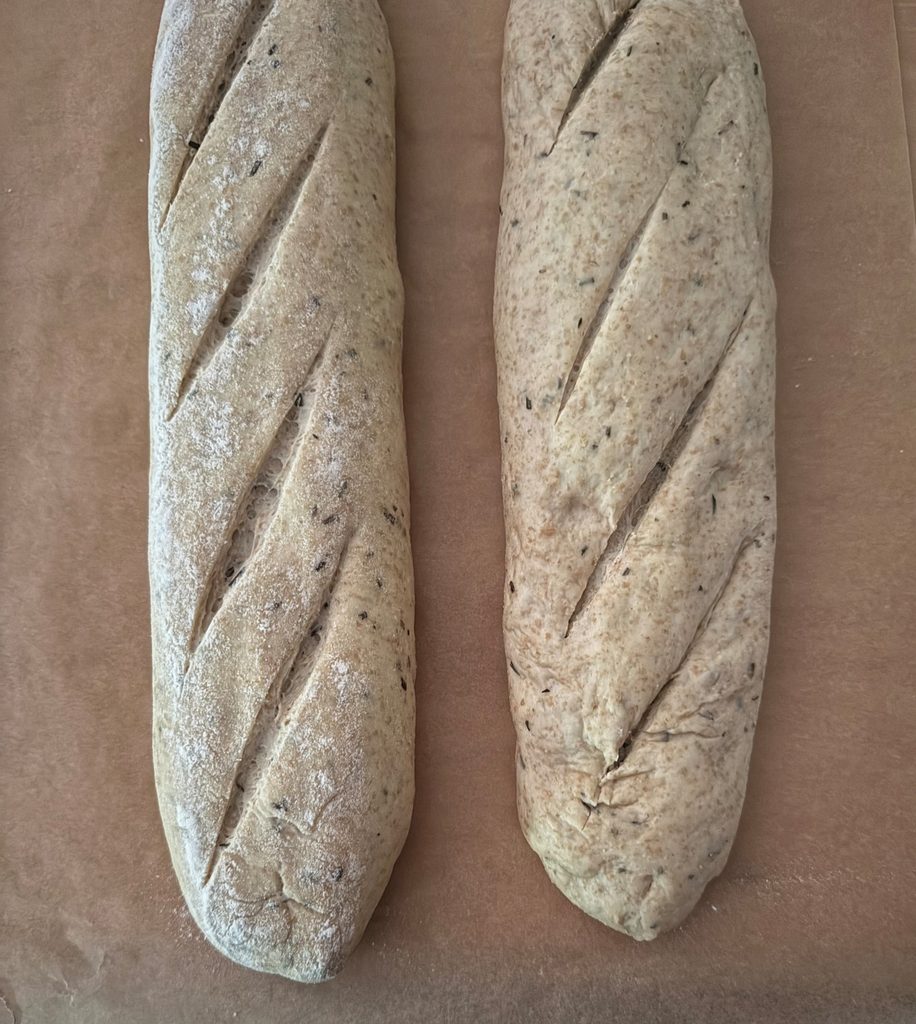
These baguettes are one of six in my free ebook, Six Seasonal Baguettes to Bake This Fall.
Sign up and it comes straight to your inbox. Get the ebook here.
What makes these olive oil and rosemary baguettes different?
It’s built on a biga. A biga is a stiff overnight preferment. You mix a little flour, water and yeast the night before, and by morning it’s domed, webbed with bubbles underneath, and smells faintly of wine. It pushes the flavor toward something winey and a little sharp, where a poolish stays milder.
This one is wetter than a classic biga. A traditional biga runs around 50% hydration and this one is nearer 66%, which is what the original recipe called for and what I have baked. It still behaves like a biga rather than a poolish. If you want the contrast sharper, take the water down to 27g.
It carries a lot of olive oil. The oil is 12% of the flour weight, which is a great deal more than most lean breads carry. It’s why a dough at 58% hydration handles like something much wetter, and it’s most of the flavor. Use oil you would happily put on bread, because that is essentially what you’re doing.
About a quarter of the flour is whole grain. I use coarsely ground whole grain einkorn, which gives this loaf its particular sweetness. Kamut, spelt, white winter wheat or ordinary whole wheat all work, and if you mill your own, mill it coarse. Don’t go hunting for einkorn on my account.
The white flour holds it up. Einkorn carries plenty of protein but forms a fragile gluten, and the olive oil shortens what gluten there is, so the white flour is the only real structure in the loaf. Stone-ground all-purpose is what I first made this with, and if you can get it, use it in place of both the all-purpose and the bread flour. Otherwise, half and half is better here than all all-purpose.
The yeast is restrained on purpose. Half a teaspoon in the final dough gives you a baguette: reasonably tight, holding its length, with the olive oil and the grain out front. Go to ¾ teaspoon if you want a loftier, more open loaf. It’s lovely in its own right, but it reads as an Italian table loaf rather than a baguette. Any more than that and the shape goes with it.
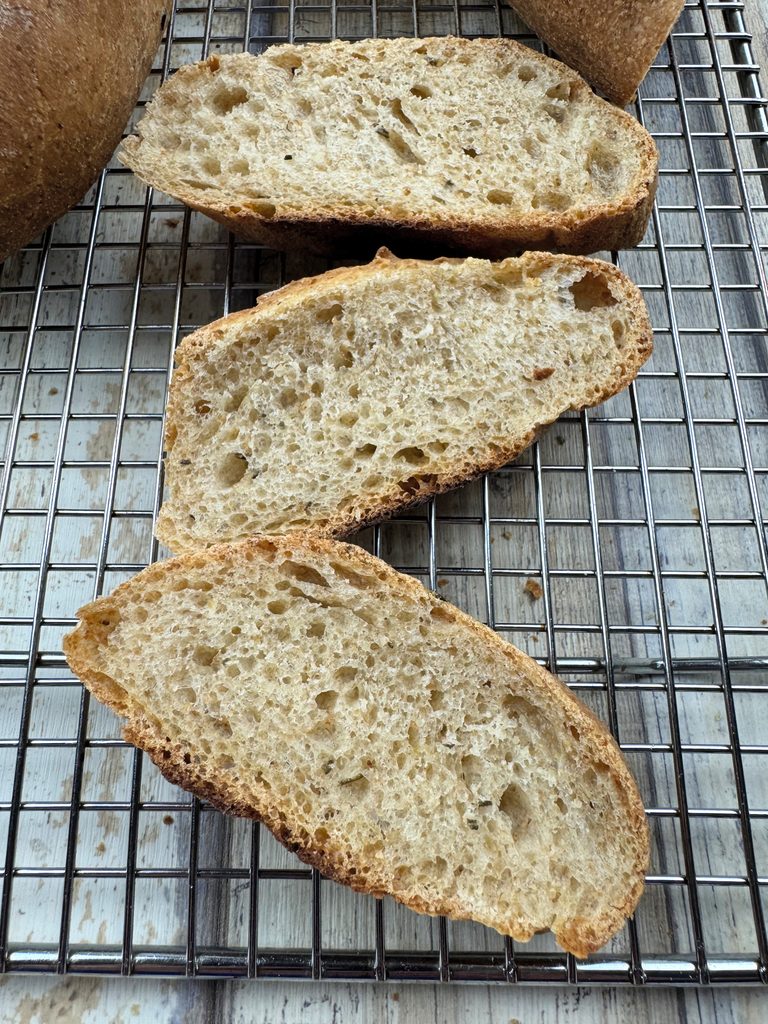
The rosemary is optional
Two tablespoons are enough to be present without becoming the whole loaf. Chop it fine, because long needles are unpleasant to bite. Leave it out entirely and you have a mixed grain olive oil bread, which is the version this started as.
When to start
Mix the biga the night before and leave it on the counter for 10 to 18 hours. The next day, allow about five hours: mix, bulk ferment 2 to 3 hours, shape, proof 1 to 1½ hours, and bake.
If an overnight shaped proof suits your schedule better, you can retard the shaped loaves in the refrigerator for 8 to 12 hours and bake from cold. It’s optional here. With commercial yeast and a biga both working, the flavor is already built.
Baking in a home oven
Place one baking stone or steel on the middle rack and a steam pan below it, and preheat both for 45 minutes at 450°F. Keep the temperature steady from beginning to end.
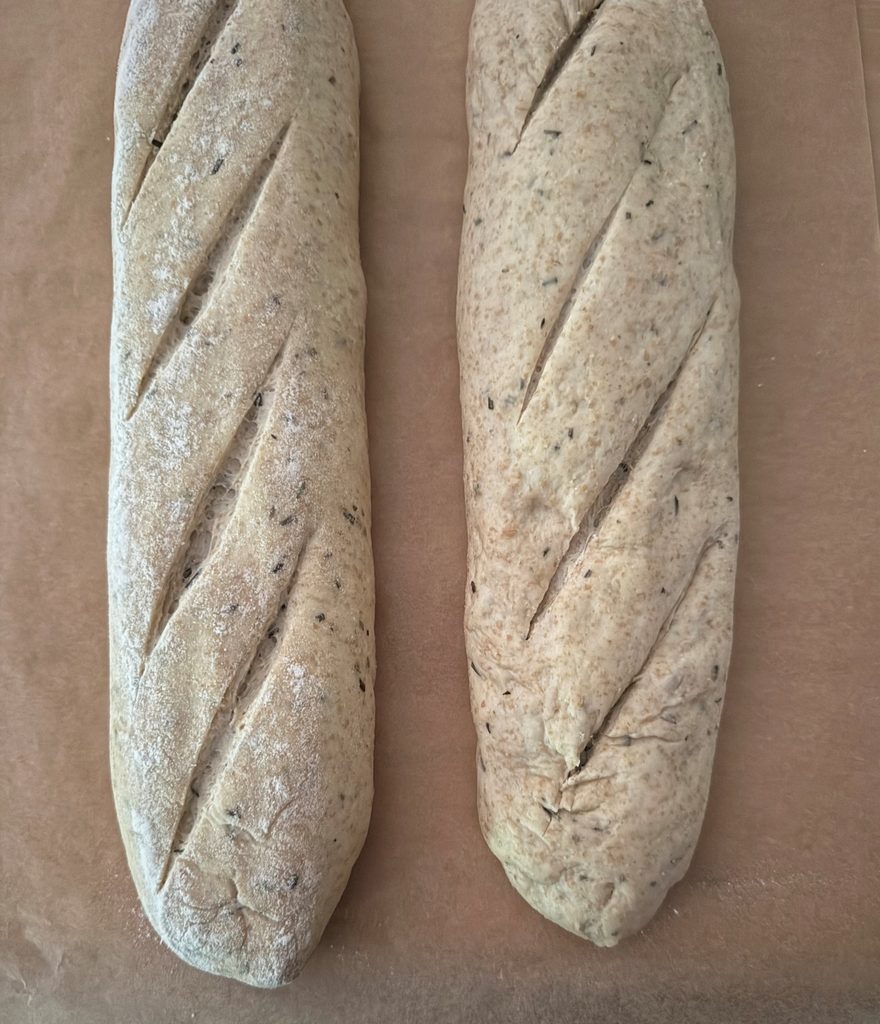
When the oven is fully preheated, turn out, score and load the loaves without delay. A loaf left sitting on parchment starts to spread before it reaches the oven. Pour one cup of hot water into the steam pan and close the door. Steam only once.
Leave the door shut unless your oven has a hot side. If it does, turn the loaves end to end after the crust has set, about two-thirds of the way through the bake.
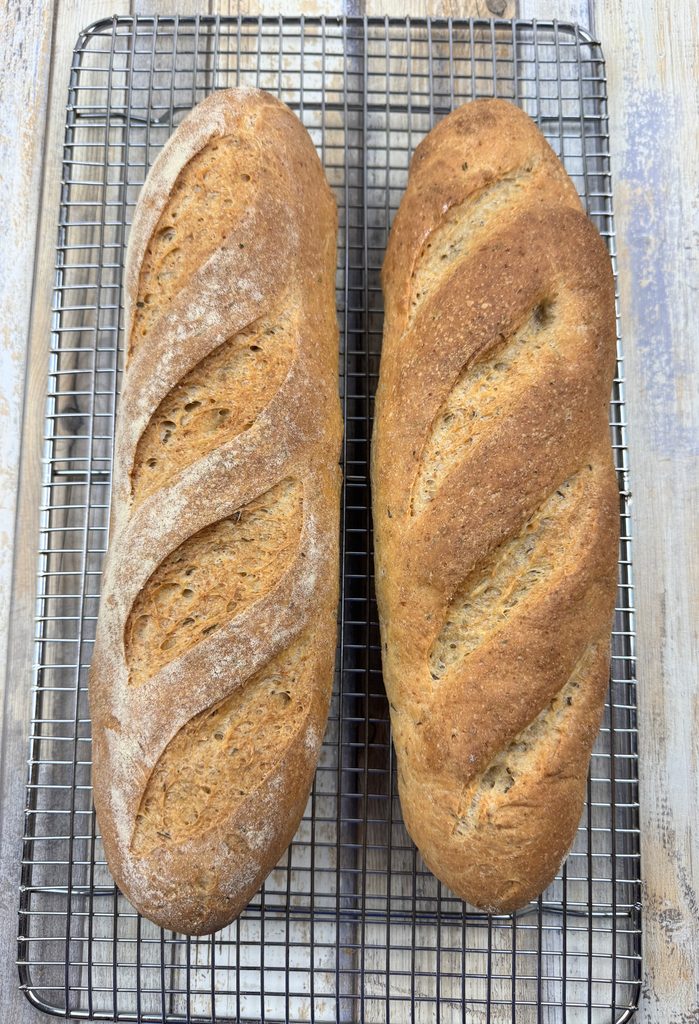
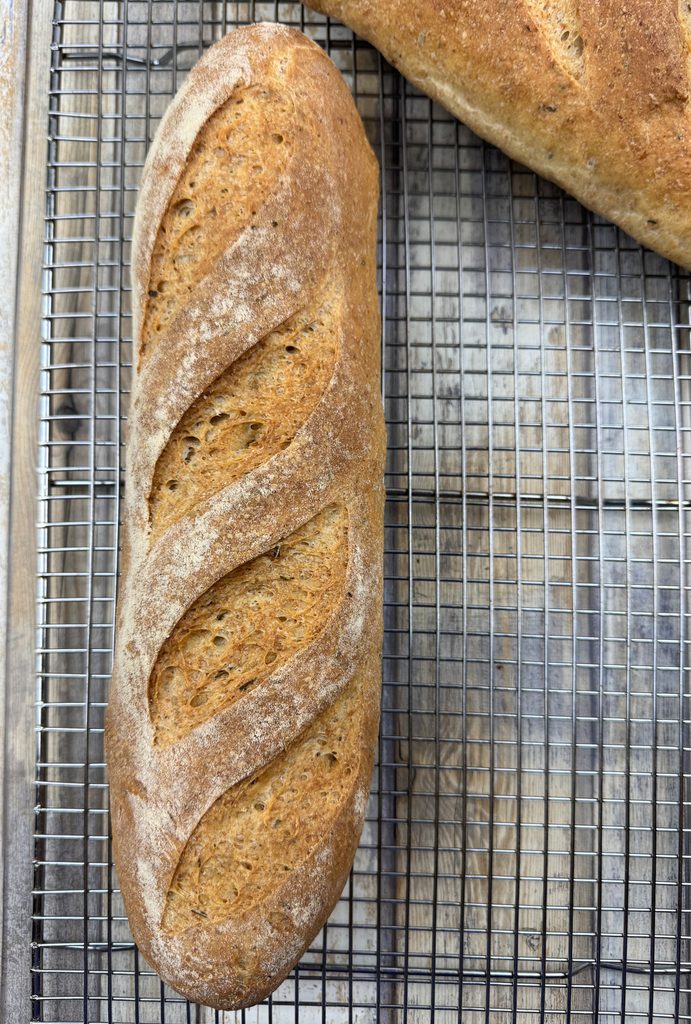
The longer end of the bake time gives a darker crust, which is how I bake this one. Color and an internal temperature of 205 to 210°F are more reliable than the clock.
Six Seasonal Baguettes to Bake This Fall
This recipe is one of six in my free ebook, Six Seasonal Baguettes to Bake This Fall.
Olive Oil and Rosemary Baguettes
- Total Time: 14 hours 4 minutes
- Yield: 2 baguettes (15 inches) 1x
Description
Two mixed-grain baguettes built on an overnight biga, with a generous amount of extra virgin olive oil and optional fresh rosemary.
Equipment: scale, baking stone or steel, steam pan, two 15-inch baguette proofing baskets or a supported couche, lame or sharp blade, instant-read thermometer (optional)
Ingredients
Biga
50g (1/3 cup + 1 Tbsp) all-purpose flour
33g (2 Tbsp + 1 tsp) water, 75 to 80°F
1/8 tsp instant yeast
Final dough
All of the biga (about 83g)
240g (1 cup) water, 75 to 80°F
50g (3 Tbsp + 2 tsp) extra virgin olive oil
1/2 tsp instant yeast
145g (1 cup + 3 Tbsp) all-purpose flour
145g (1 cup + 2 Tbsp) bread flour, 12 to 12.5% protein
135g (1 cup + 2 Tbsp) whole grain flour, coarsely ground
10g (1 3/4 tsp) fine sea salt
2 Tbsp fresh rosemary, finely chopped (optional)
Instructions
Make the biga. The night before, mix the flour, water, and yeast into a stiff, shaggy paste. Cover and leave 10 to 18 hours at room temperature, until domed, webbed with bubbles underneath, and faintly winey.
Mix. Combine the biga, water, olive oil, and yeast, and stir for about 30 seconds to break the biga up. Whisk the three flours, salt, and rosemary together separately, then add them.
Knead. Three minutes on low with a paddle, then five minutes on low with the dough hook. By hand, 8 to 10 minutes. It comes together into a smooth, supple, slightly slack dough.
Bulk ferment. Clean bowl, covered, 2 to 3 hours at room temperature, until really puffy and close to doubled. Half a teaspoon of yeast makes for a slow bulk, and in a cool kitchen it may want longer than three hours. Watch the dough rather than the clock.
Divide and preshape. Divide into two pieces of about 400g. Deflate gently, gather the edges into a ball, tighten the surface with circular motions on an unfloured patch of counter, then elongate into an oval. Cover and rest 10 minutes.
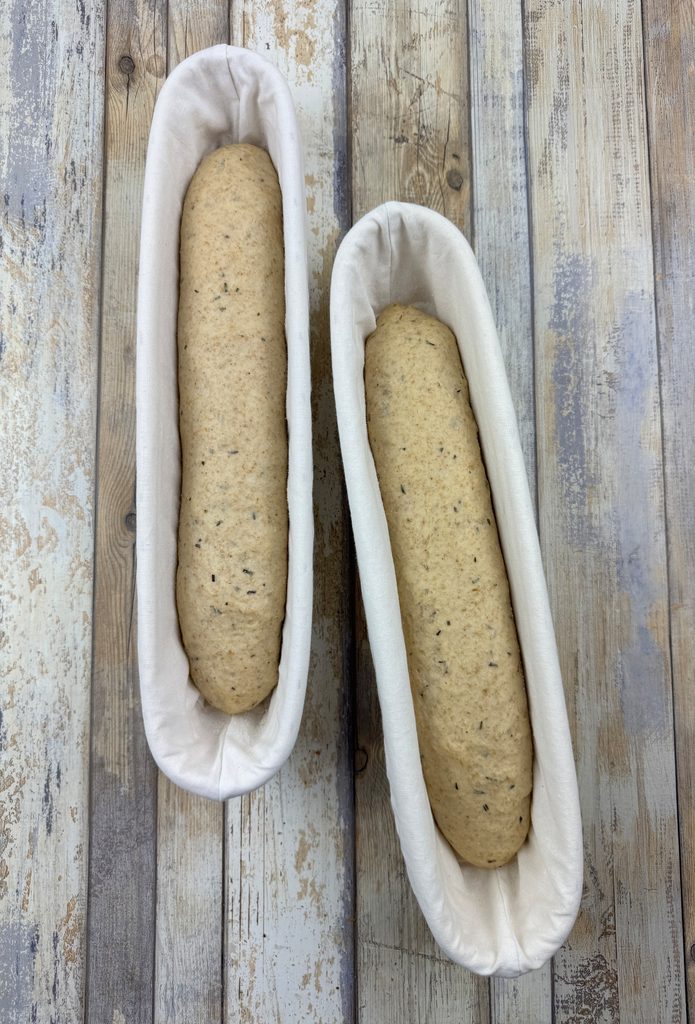
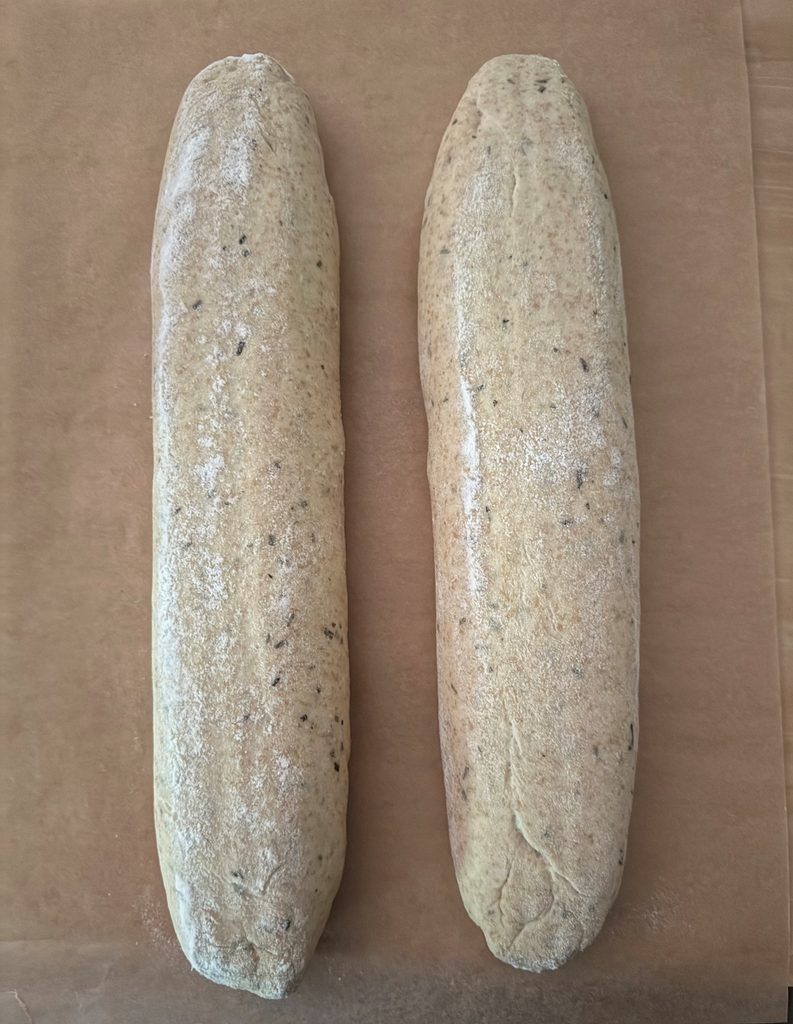
Shape. Flatten each piece into a rectangle, fold the top third down, fold in half lengthwise, and seal the seam with the heel of your hand. Roll into a long taper that fills the 15-inch basket end to end, easing the ends thinner as you go. If it springs back and refuses to lengthen, rest it five or ten minutes under a cloth and come back to it rather than forcing it. Place seam side up in a well-floured basket or couche.
Preheat. Place a baking stone or steel on the middle rack and a steam pan below it. Preheat both for 45 minutes at 450°F.
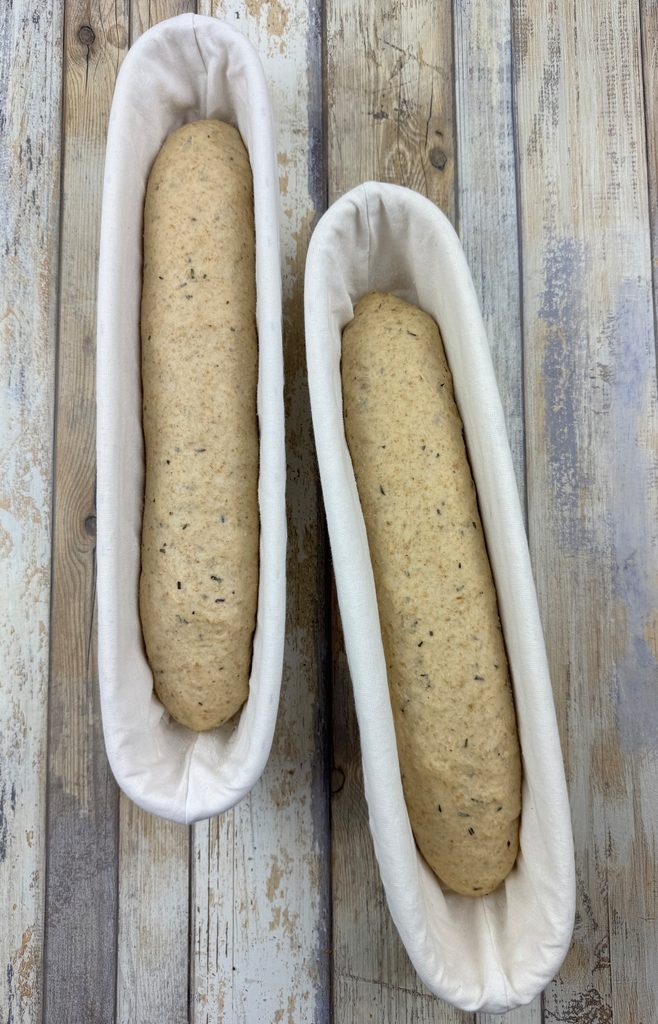
Final proof. 1 to 1½ hours, until a floured fingertip leaves a dent that fills back slowly.
Bake. Turn out, score, and load without delay. Pour one cup of hot water into the steam pan and close the door. Steam only once. Bake 20 to 24 minutes for two baguettes, to an internal temperature of 205 to 210°F. The longer end gives a darker crust.
Cool completely. At least 45 minutes on a rack.
Notes
Sizing. Bake all at 450°F throughout.
- One baguette (half the recipe), about 400g: 18 to 22 minutes
- Two baguettes (full recipe), about 400g each: 20 to 24 minutes
- Two bâtards (full recipe), about 400g each: 28 to 33 minutes. Shape them nine to ten inches long and proof seam side up in an oval basket or on a supported couche.
To make one loaf, halve everything. The biga yeast stays at ⅛ teaspoon rather than halving since it’s already the smallest measure worth naming.
Weigh your flour. Volume measures are included, but the gram weights are the tested version.
Yeast. ½ teaspoon is the tested amount. ¾ teaspoon gives a loftier, more open loaf with a shorter bulk.
Cold retard. Optional. Retard the shaped loaves 8 to 12 hours and bake straight from the refrigerator.
Hot side. If your oven bakes unevenly, turn the loaves end to end after the crust has set, about two-thirds of the way through.
Adapted from the Bread Baking Babes challenge of April 2021.
- Prep Time: 30 minutes. Mixing the biga, mixing and kneading, then preshaping and shaping.
- Biga and rising: 13 hours 10 minutes
- Cook Time: 24 minutes
- Category: Baguettes
- Method: Biga
- Cuisine: French
Serving and storing
Serve it with good olive oil in a shallow dish.
Baguettes are best the day they’re baked, but the olive oil keeps this one softer into the next day. For longer storage, wrap tightly and freeze for up to three months.
Reheat from frozen, unwrapped, at 325 to 350°F for 15 to 20 minutes. Wet the crust first for a crisper finish, or cover it loosely with foil for a softer one.
Prefer sourdough?
A sourdough version of this olive oil and rosemary dough is also on the blog. It runs wetter, carries the rosemary as standard, and is shaped into bâtards.
Happy baking!
Cathy
Leave a Reply