
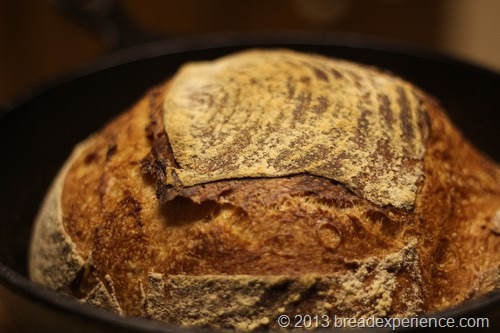
This white bread with poolish is based on the Forkish method from Flour, Water, Salt & Yeast and is baked in a Dutch Oven Combo Baker. When I removed the loaf from the oven, it crackled in my ear. It was such a lovely sound!
Now and then, you run across a gem. You know you’re onto something because it just resonates with you. It’s not something you can explain, but you know it when it happens.
Well, it happened to me this past weekend. I ended up not going to the Asheville Bread Festival as I had planned, and I was bummed.
I had been pushing myself too hard recently, and I just had to rest. So, instead of fighting it like I normally do, I took a break from everything and spent time catching up with myself. It rained most of the weekend, so it was a good time to hibernate.
While I was sitting there trying to relax (which, if anyone knows me, is a feat in and of itself), I picked up a bread book that I had gotten recently. The book is called Flour Water Salt Yeast: The Fundamentals of Artisan Bread and Pizza by Ken Forkish.
Note: I did not receive a free copy of the book in exchange for a review. I bought the book myself, and I love it.
Mr. Forkish’s method is inspired by the processes of Jim Lahey (My Bread) and Chad Robertson (Tartine Bread).
One of the reasons I like this book so much is that all of the formulas are based on 1000 grams of flour, which makes it so easy to follow and adapt. He also provides tips on adapting his recipes. Nothing is left to chance.
I was so inspired by the book that I had to bake some bread. I chose this white bread with poolish because it doesn’t require much hands-on time on the first day, which in my case was Saturday. I finished it Sunday afternoon, and it lifted my spirits.
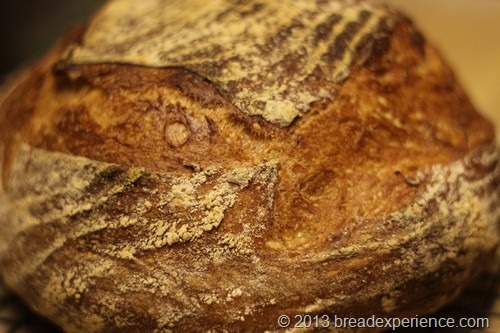
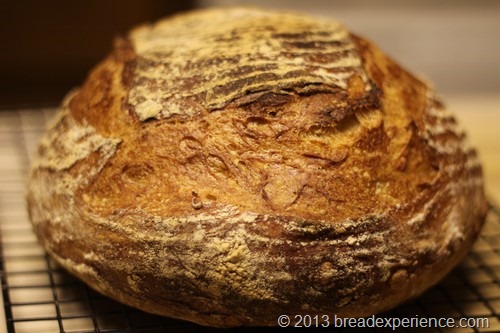
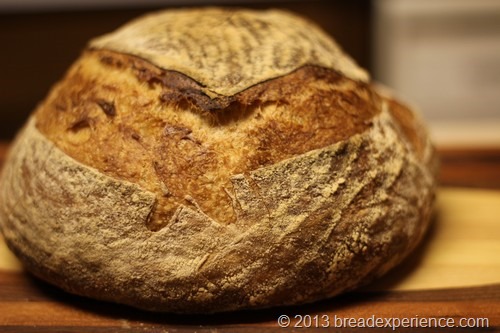
I fell in love with this bread the minute I took it out of the oven. I placed it on the wire rack to cool, and as I was taking photos, it started to sing. It was a delightful melody. It crackled ever so lightly like a lover whispering in my ear.
I don’t know if I was just so spacey from exhaustion or what, but all I could think at the time was “I’m in love.”
Baker’s Formula for White Bread with Poolish:
| Ingredient | Quantity in Poolish | Total Recipe Quantity | Baker’s Percentage |
| Bread flour | 250 g | 500 g | 100% |
| Water | 250 g | 375 g | 75% |
| Sea salt | 0 | 10 g | 2.0 % |
| Yeast | 0.4 g | 2 g | 0.40 % |
| Poolish | 50%* |
*Note: The baker’s percentage for the poolish is calculated by taking the amount of flour in the poolish and dividing it by the total flour in the recipe (250 grams / 500 grams = 50%).
Print
Sing to me my bread & crackle sweetly in my ear
- Yield: 1 Loaf 1x
Description
This white bread with poolish is based on the Forkish method from Flour, Water, Salt & Yeast and is baked in a Dutch Oven Combo Baker.
Ingredients
Poolish:
250 g (1 7/8 cups +1 tbsp.) white bread flour
250 g (1 1/8 cups) water, 80 degrees F.
0.4 g (scant 1/8 tsp.) instant dried yeast
Final Dough:
250 g (1 7/8 cups + 1 tbsp.) white bread flour
125 g (1/2 cup) water, 105 degrees F.
10 g (~1 3/4 tsp.) fine sea salt
1.6 g (1/2 tsp.) instant dried yeast
500 g Poolish, all of the above
Instructions
1) Make the Poolish
The night before you plan to bake the bread, whisk the flour and yeast together in a large bowl and add the water. Mix by hand or with a wooden spoon until it is thoroughly blended. Cover the bowl with plastic wrap and let it sit at room temperature (65 to 70 degrees F.) for 12 to 14 hours. When the poolish is ready, it should be bubbly and almost tripled in volume.
2) Mix the Final Dough
The next day, after the poolish is fully mature, whisk together the flour, salt, and instant yeast in a large bowl. Pour the water around the edges of the poolish to loosen it from the bowl. Pour the water/poolish mixture into the flour mixture.
For the next part, you’ll need to get your hands wet. Using wet hands, mix the dough by folding it to thoroughly incorporate all of the ingredients (refer to my post on making Tartine Country Bread). The dough should be around 74 – 75 degrees F.
3) Bulk Fermentation
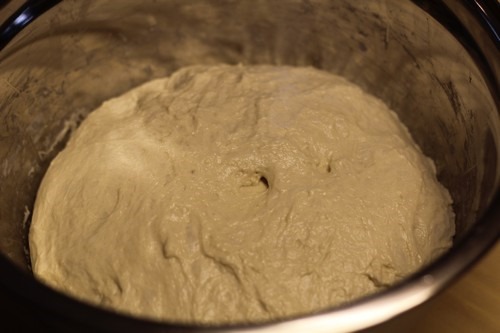
Let the dough rest for 2 to 3 hours after mixing. During this time, do two or three folds during the first hour after mixing the dough. I forgot to use 105 degrees F. water when I mixed the dough, so I extended the bulk fermentation another hour to compensate for the overall temperature of the dough being lower. I did several folds and turns during the first hour, then I let the dough rest for the remainder of the proof.
4) Shaping the loaf
Mr. Forkish has a slightly different process because he bakes his loaf in a Dutch oven and shapes his loaves into a fendue shape. I shaped my loaf differently and baked it in my combo baker, so this is the process I used. If you choose to use a different type of bread baker, you might need to adjust the shaping/scoring part so you don’t burn yourself when inverting the dough into the pot.
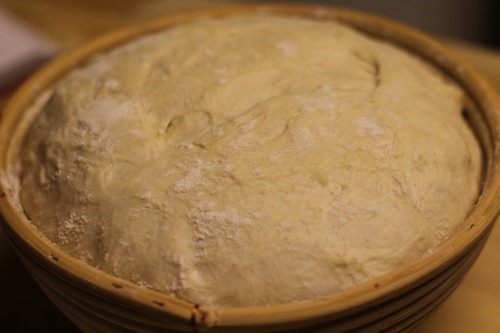
I only made one loaf, so I didn’t need to divide the dough. I just carefully scraped the dough onto a lightly floured surface and shaped it into a medium-tight ball. Then I placed it seam-side up in a floured banneton basket. I used an 8-inch round proofing basket, but you could use a larger one if desired.
5) Proof the loaf
I lightly floured the top of the loaf and covered it with a kitchen towel. Then I let the loaf proof in the basket for an hour.
Use the finger-dent test to know when the dough is fully proofed and ready to bake. This just means you press your index finger lightly into the dough, and if the indentation remains, the dough is ready.
6) Prepare the oven for Hearth baking
While the loaf is proofing, at least 45 minutes before it’s time to bake, preheat the oven to 475 degrees F. with the combo baker, Dutch oven, or other bread baker on the bottom rack. There’s no need to place a steam pan underneath. The covered pot will provide the steam.
7) Scoring the loaf
For this part, be very careful not to burn yourself because you’ll be working with a very hot pan. Keep your fingers, forearms, and anything else away from the hot pot. A large heat-resistant oven mitt works wonders.
Carefully remove the preheated combo baker (using gloves) and invert the proofed loaf onto the bottom of the baker. My loaf didn’t plop exactly in the center of the pan, so I shook the pot to even it out, but it was still a bit uneven.
Then I carefully scored the loaf using a lame. Even though the rings of flour were a bit off in the pan, I thought the scoring turned out pretty well.
8) Bake the loaf
Cover the combo baker with the lid and place it on the bottom rack to bake. Bake the loaf for 30 minutes, then uncover the combo baker, and bake for an additional 20 to 30 minutes. This is what the loaf looked like when I removed the lid.
The finished loaf should be at least medium-dark brown all around the loaf. This has always been the hard part for me because I don’t like to burn my bread, but I was a good girl and left the loaf in for the suggested amount of time. However, if your oven is hot like mine, you might want to check the loaf sooner.
9) Cool the Loaf
Carefully remove the combo baker from the oven and gently tilt it to remove the loaf. I just reached in using my oven mitt and lifted it out. Place the loaf on a wire rack and let it rest for at least 20 minutes before slicing.
Notes
Adapted from: Flour Water Salt Yeast: The Fundamentals of Artisan Bread and Pizza by Ken Forkish
- Category: Bread
- Method: Yeast
- Cuisine: French






After I let the loaf cool, I just couldn’t bring myself to slice it just yet. I wanted to look at it a little longer. So I placed the cooled loaf in a paper grocery bag and let it sit overnight.
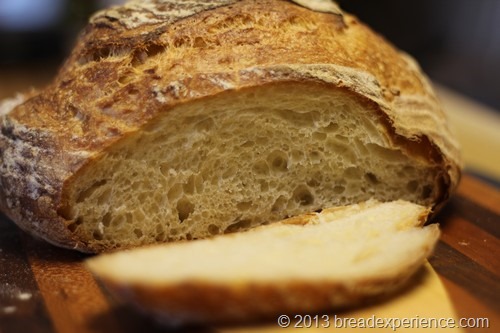
The next day, I sliced the loaf and sampled it. I was not disappointed. It’s great with butter or dipped in oil and tastes particularly good toasted with sharp cheddar cheese. It also makes a great sandwich bread. I’ve been enjoying it all week.
And so, my love affair with bread begins anew with this White Bread with Poolish.
I hope you enjoy this bread as much as I did.
This bread has been YeastSpotted in the weekly bread roundup hosted by Susan of Wild Yeast.
Happy Baking!
Cathy
Leave a Reply