
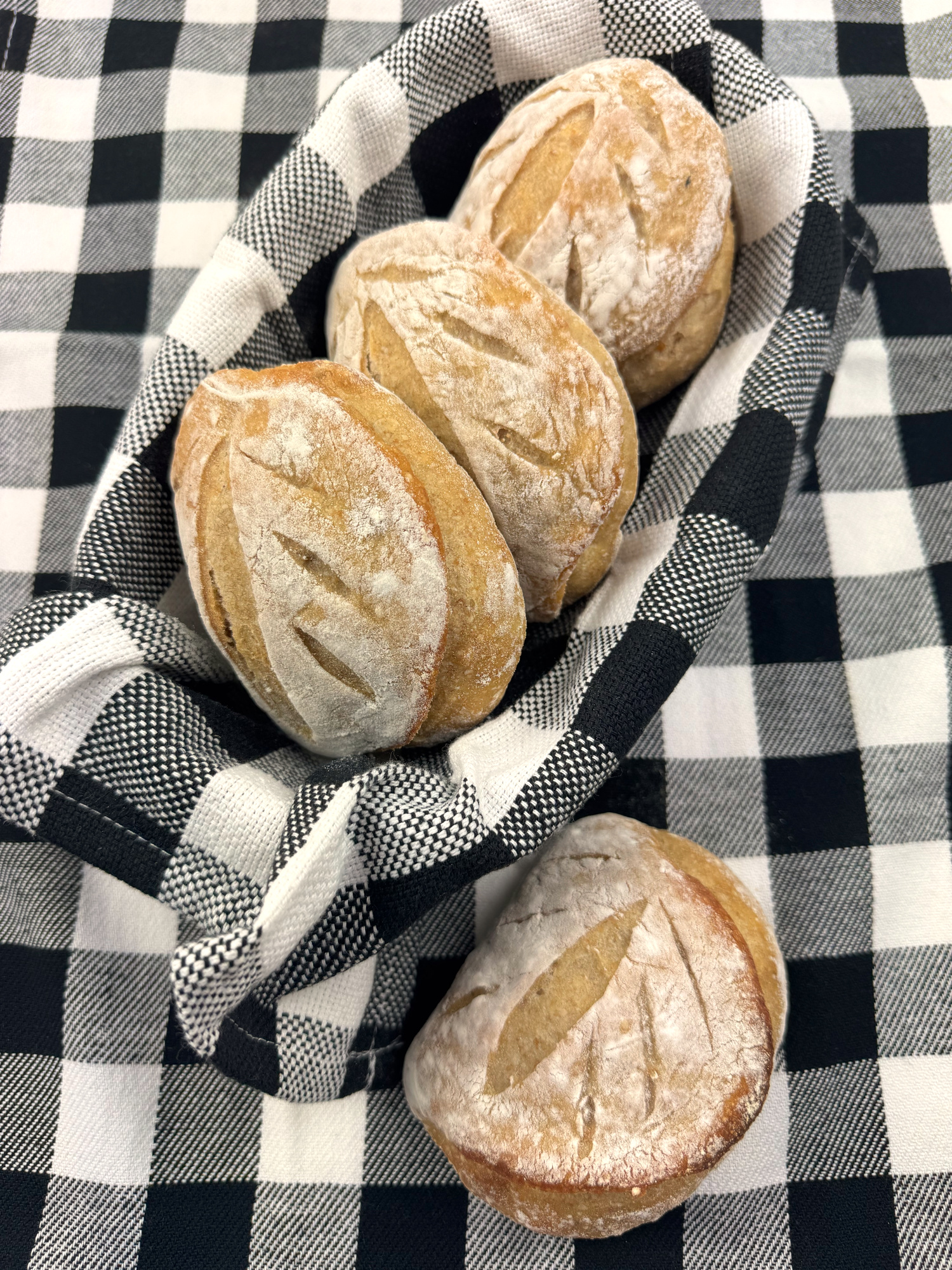
The Tabatière is a French snuffbox loaf made easy with an overnight poolish. No starter needed, plus rye, whole wheat, or spelt options and four loaf sizes.
Tabatière is typically made from a plain French lean dough. To create the signature snuffbox look, the flap is folded over the top. Underneath, it is an everyday white bread, which gives you plenty of room to play with.

I’m the host kitchen for the Bread Baking Babes, and I chose this easy and fun bread as a change of pace for summer baking.
I got the idea for this bread from The Larousse Book of Bread by Eric Kayser. His version is made with all-purpose flour, a straight sourdough, plus a bit of fresh yeast.
My version is built around an overnight poolish so everyone can bake it, whether or not you keep a sourdough starter. The poolish brings the flavor, and a small amount of dried yeast in the dough keeps the timing predictable so you aren’t waiting all day for the dough to proof.
The times below should be treated as a guide. Pay attention to the dough as you go. In a hot kitchen, it will proof faster; in colder kitchens, the dough tends to be more sluggish.
You can make this a light wheat loaf by folding in a little rye, whole wheat, or spelt into the dough, around 15 percent, to give the crumb some character. Once you go beyond 25 percent whole grain, the flap tends to get stickier and requires more rye dusting to keep it from sealing.

Feel free to take liberties with the type of whole grain you use. I tested several batches using either rye or spelt in the dough. My favorite version features spelt in the dough with rye dusted under the flap.
Since whole grain and home-milled flours absorb more water and make the dough a bit slacker, this one is developed with a few stretch and folds rather than kneaded into a smooth ball.
Choose your loaf size
This one batch can be divided however it suits your table. The dough and method stay the same. Only the flap length and total bake time shift with the size. For each size, I like to bake the first 10 minutes on the stone, then finish on the rack above. If you prefer a softer crust and crumb, bake it on a baking sheet without the stone, but use steam to ensure the flap opens.
- One loaf, about 510 g. A shareable centerpiece, more like a Pain de Campagne with a flap. Flap around 6 inches (15 cm). Bake 30 to 35 minutes.
- Two loaves, about 255 g each. Small shared loaves. Flap around 5 inches (12 to 13 cm). Bake 20 minutes.
- Three loaves, about 170 g each. Small loaves, though still a hearty portion for one. Flap around 4 inches (10 cm). Bake 18 to 20 minutes.
- Four loaves, about 130 g each. Tidy single-serving loaves, one per person. Flap around 3.5 inches (9 cm). Bake 15 to 18 minutes.
I tested two loaves, three loaves, and four loaf batches. For true one-person loaves, I think four is the way to go. When I baked three loaves, they were still a little large for a single serving. I would not go smaller than four, though. Below about 100 g, the flap gets fiddly to roll, and the snuffbox shape loses its definition.
Whatever size you choose, remove the loaves when they are golden and sound hollow rather than relying strictly on the clock.


Timing at a glance
The night before
- Build the poolish, seeded with a pinch of yeast or a little starter
- Leave it out for 10 to 14 hours, until bubbly and domed
The day of
- Mix the flour and water, rest for 1 hour
- Add the poolish, salt, and yeast, and mix to a shaggy dough
- Two stretch and folds 30 minutes apart, then rest, about 1.5 to 2 hours
- Divide, shape into balls, then rest 30 minutes
- Pre-shape, then roll and fold the flap
- Proof flap down, 1 to 1.5 hours
- Flip flap up, score a leaf, steam well, and bake at 450°F (230°C), about 20 minutes for small loaves


About the flour
The total flour is 300 g, which is about 70 percent hydration at the base water and closer to 80 percent with the extra. Start with 105 g of water and add the rest as needed until the dough is soft but workable. Whole grain and home-milled flours will absorb the most.
The rye will be a bit sour and tacky; the whole wheat will provide a nuttier flavor with more structure. If you use spelt, it will be sweet and mellow but a slack dough. My test bakes started with home-milled whole grain spelt, I switched to home-milled whole grain rye for one bake, and back to spelt. Each time, the dough needed extra water.
Use rye for dusting regardless of the type of flour you incorporate in the dough. The rye gives the flap its floured, rustic contrast and keeps it from fusing during the final proof.
Tabatière: French Snuffbox Loaf (Overnight Poolish)
- Total Time: about 5 hours, day of
- Yield: 2 loaves (scalable, 1 to 4) 1x
- Diet: Vegan
Description
Tabatière is a French snuffbox loaf made easy with an overnight poolish. The flap, which is folded over the top, is what gives it the snuffbox look.
Ingredients
Poolish:
- 60 g (1/2 cup) all-purpose flour
- 60 g (1/4 cup) water, cool if your kitchen runs warm
- Seed: a pinch of instant yeast (about 1/16 tsp), OR about 12 g (1 Tbsp.) active sourdough starter
Dough:
- 195 g (1 1/2 cups + 2 Tbsp.) all-purpose flour
- 45 g (6 Tbsp.) rye, whole wheat, or spelt flour
- 150 g (scant 2/3 cup) water at 68°F (20°C), plus 25 to 30 g (about 2 Tbsp.) more for whole grain or home-milled flours
- 6 g (1 tsp.) fine sea salt
- 0.7 g (scant 1/4 tsp.) instant dry yeast
- All of the poolish
- rye flour for dusting
Instructions
The night before: poolish
Build this 10 to 14 hours ahead. There are two ways to seed it: instant yeast or sourdough starter.
Add the ingredients to a small bowl and mix to a thick batter. Cover the bowl tightly, and leave at room temperature. You will know it’s ready when it is noticeably bubbly, domed, and just beginning to sink in the center. Use all of it.
The dough:
Rest the flour and water. Combine the all-purpose flour, rye, whole wheat, or spelt, and water. Mix until no dry flour remains. Cover and let it rest for 1 hour. This soak softens the whole grain and helps the gluten begin to develop.
Mix in the poolish, salt, and yeast. Add all of the poolish, the salt, and the instant yeast. Mix into a shaggy dough. The dough doesn’t need to be smooth at this point. With the extra water and any whole grain, this will be a slack dough, so the strength will be built with folds rather than kneading it into a ball.
Develop with folds, then rise. Give the dough 2 stretch and folds, about 30 minutes apart. Each time, reach under one side, stretch it up, and fold it over the top, working around the bowl four times or so. After the second fold, cover, and let it rest 30 minutes to 1 hour, until puffy and risen by about half. Between the soak, the folds, and the rest, the first rise will run about 1.5 to 2 hours.
Divide and rest. Dust your work surface with all-purpose flour. Divide the dough into 2 equal pieces, or more if you want smaller loaves (see Choose your loaf size). Shape each piece into a ball without working it too hard. Cover and rest for 30 minutes.
Pre-shape. Turn each ball so the seam is on top. Bring the edges to the center and press down gently. Turn the dough over and roll it on the work surface, pressing lightly, to form a smooth, even ball.
Shape the flap. With a rolling pin, flatten and roll about a third of each ball out and away from you, creating a flap (see Choose your loaf size for length). Dust the flap lightly with rye, then fold it back over the top of the loaf.
Proof. Place the loaves on a well-floured cloth or a heavily floured work surface, with the flaps underneath. Cover with a damp cloth and proof until puffy and slightly springy, roughly 1 to 1.5 hours. The dough should hold a slow dent when pressed gently, springing back partway rather than all the way.
Bake with steam. Preheat the oven to 450°F (230°C) with a baking stone on a middle rack and a metal pan on the shelf below or on the oven floor. A stone provides the best crust and lift, but steam is the part that matters the most, so don’t skip it even if you bake on a baking sheet only.
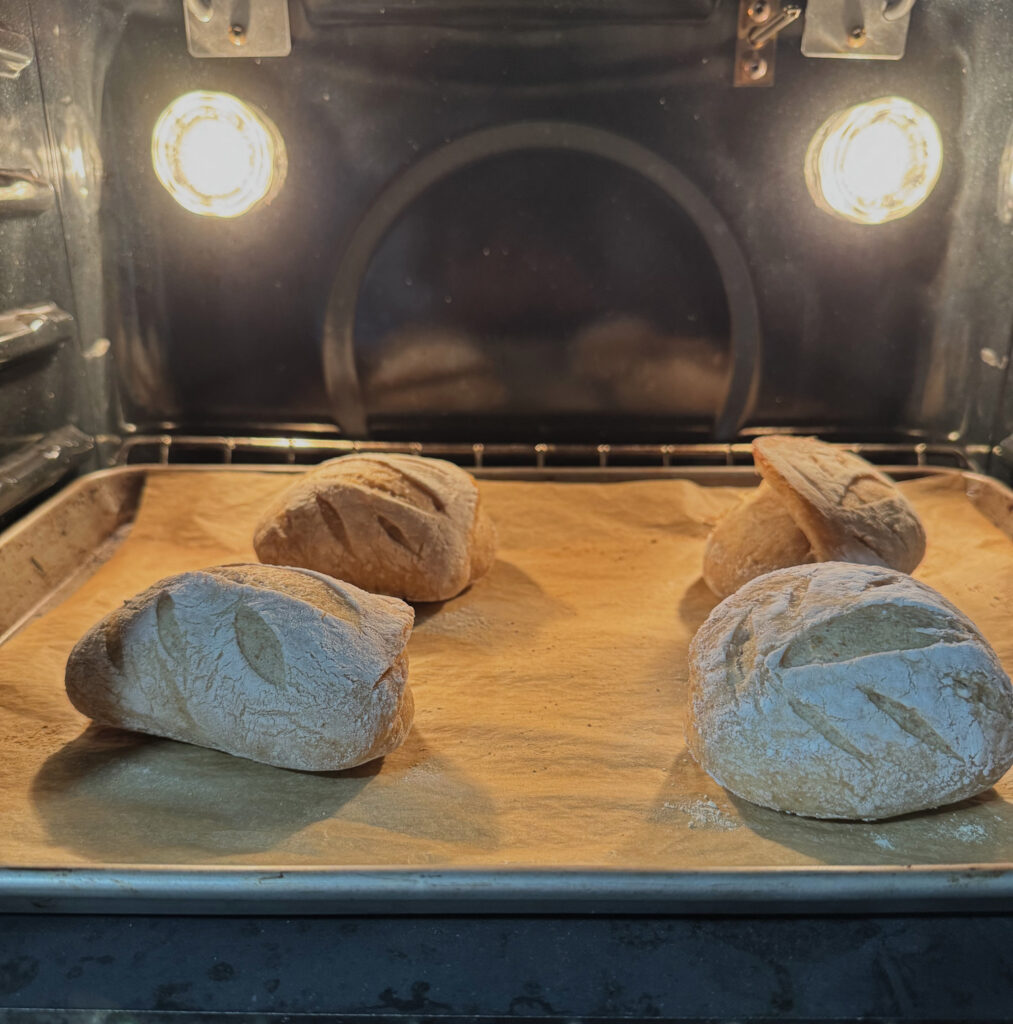
Turn the loaves onto parchment, flaps now on top, and score a leaf pattern. Slide the loaves onto the stone and pour about 50 g (scant 1/4 cup) of hot water into the preheated pan to steam.
Bake 10 minutes. Then move the loaves up to the rack above, onto a baking sheet, rotating them for even color, and bake until golden and hollow-sounding, about 10 minutes more for small loaves. Larger loaves will need to bake longer up top (see Choose your loaf size).
Cool. Remove the loaf from the oven and place on a wire rack to cool.
Notes
This one batch can be divided however it suits your table. The dough and method stay the same. Only the flap length and total bake time shift with the size. For each size, I like to bake the first 10 minutes on the stone, then finish on the rack above. If you prefer a softer crust and crumb, bake it on a baking sheet without the stone, but use steam to ensure the flap opens.
- One loaf, about 510 g. A shareable centerpiece, more like a Pain de Campagne with a flap. Flap around 6 inches (15 cm). Bake 30 to 35 minutes.
- Two loaves, about 255 g each. Small shared loaves. Flap around 5 inches (12 to 13 cm). Bake 20 minutes.
- Three loaves, about 170 g each. Small loaves, though still a hearty portion for one. Flap around 4 inches (10 cm). Bake 18 to 20 minutes.
- Four loaves, about 130 g each. Tidy single-serving loaves, one per person. Flap around 3.5 inches (9 cm). Bake 15 to 18 minutes.
Whatever size you choose, remove the loaves when they are golden and sound hollow rather than relying strictly on the clock.
- Prep Time: 30 min
- Cook Time: 20 min
- Category: Bread
- Method: Poolish
- Cuisine: French
Serving Tabatière through the seasons
This is an everyday table bread. What changes throughout the year is what you serve with it.
In summer, serve it as a sandwich loaf for picnics or simple dinners. During peak tomato season, it works well for bruschetta. Use ripe tomatoes and good olive oil on toasted slices. The crisp flap provides a nice contrast against the soft crumb.
Day-old loaves are ideal for panzanella, soaking up tomato juice and vinaigrette without getting mushy. This makes a nice second-day use once your loaf has cooled overnight.
For a summer board, create bright flavors with burrata or fresh chèvre, stone fruit, basil, and a thread of honey. The small individual loaves are perfect for a picnic, one per person tucked in a basket with cheese, charcuterie, and whatever fruit is ripe and in season.
In fall and winter, it serves as a soup-and-stew bread. It’s lean enough to tear and dip, yet sturdy enough to mop a bowl clean. Serve it with a squash or lentil soup, a braise, or a pot of beans.
When creating a board, shift toward aged cheeses, figs and quince, toasted nuts, and honey or chutney. Day-old loaves are good for ribollita or bread soup, and the crust takes well to toasting for a cheese plate. If you bake it as one larger loaf, this is the season for it. Set it on the table to share.

A few notes
The times in steps 3 and 7 are guides, not rules. A warm kitchen will move things along more quickly; a cool day will stretch them out. The dried yeast keeps things on track even if your poolish starts out a little sluggish. However, a well-domed poolish still provides the best flavor and lift, so give it the full overnight rest.
Hold back a little of the extra water at first if you are unsure how your flour will absorb it, then work it in during the folds. Whole grain and home-milled flours can always absorb more hydration, but a commercial all-purpose flour may not want the full amount.
If your flap keeps sealing back down during the proof, dust it with more rye flour between the flap and the loaf, and use slightly drier hands when you fold it over.
Steam is the most important part of this bake. However you set up your oven, whether you use a baking stone or just a baking sheet, get a good burst of steam during the first ten minutes for a crisp, glossy crust.
Who are the Bread Baking Babes?
We are a group of bakers who bake bread together every other month! I’m the host kitchen this month.
There’s something extra special about baking with friends, even when those friends are scattered across the world.
Please join us in baking Tabatière, and share your results.
Check out our Facebook group and the BBB blogs (links below) to see our baking results.
Bread Experience – Cathy (host kitchen)
My Kitchen in Half Cups – Tanna
A Messy Kitchen – Kelly
Karen’s Kitchen Stories – Karen
Judy’s Gross Eats – Judy
blog from OUR kitchen – Elizabeth

Happy Baking!
Cathy
Leave a Reply